Thoughts of the Week.
In the classic ’80s romantic comedy “When Harry met Sally” , the hilarious Billy Crystal meets the cute Meg Ryan and during the course of the next 12 years they initially dislike each other, then become friends, they form failed relationships with others, and eventually fall in love and get married. In a few days, the world will be hoping for an equally positive outcome, albeit less romantic.
Trump will bulldoze himself into another international minefield when he travels to Beijing on Thursday for a two-day summit with President Xi Jinping, and popcorn is getting prepared for yet another episode of US-China’s long-standing relationship to go “on air”. After a string of humiliating policy implosions over Ukraine, Gaza, Greenland, and now Iran and Lebanon, Trump is in desperate need for a diplomatic success to show at home. He needs Xi’s promise not to arm Iran if there is an escalation, but primarily he would “beg” for his help to open the Hormuz strait.
The two superpowers have been in and out of a “romantic” relation for decades. In the earliest part of the century there was serious flirting in the air. In 2006, President George W. Bush started the U.S.–China Strategic Economic Dialogue with the grandiose goal of being a “G2,” as people then described it. It was expanded by President Obama three years later into the Strategic and Economic Dialogue, but this was discontinued in 2017 during Trump’s first term. Likewise, the Joint Committee on Commerce and Trade which was established back in 1983 had its last meeting in 2016. But while Trump can be considered the one who decided the divorce, Joe Biden, also took a hawkish path by barely engaging at all with China and becoming the first sitting U.S. President, since the normalization of relations, not to visit the country.
Trump is going into the summit with a weak hand, although he usually claims he has all the cards. He even made an AI-generated image of him with all the strong cards of a famous game, but he was probably not informed that this is usually the loser and not the winner in a game called … UNO. China’s Xi knows that the Iran war is deeply unpopular with US voters. Trump is universally blamed for pushing up global energy, food and medicine prices. European allies have refused to bail him out and Russia is undeservedly benefiting from inflated oil prices. Trump is not winning militarily, either, as shown by his on-off Project Freedom.
What will Xi make of his furious and volatile guest? For China, Trump is the gift that keeps on giving. Thanks to him, the US is increasingly viewed internationally as an aggressive potential enemy or unreliable friend. Trump’s volatility assists Xi’s promotion of China as the new guardian of global stability. The downside for Xi is the negative impact of the war on energy prices, global trade and export demand at a time when China’s economy is already struggling. Last year, about 80% of Iranian oil shipments were bought by China – shipments the US navy is now blocking. So far, Beijing has largely managed to offset this by drawing on reserves, capitalizing on green energy and buying more oil from countries such as Brazil and Russia. But for the world’s largest importer of crude oil, safe and reliable navigation through the strait of Hormuz is critical. Hence, Xi should be willing to make concessions, especially if Trump “gives away” Taiwan to him. Recent comments from Trump and the fact that a 14bn$ package aimed for Taiwan is still sitting on his desk for approval point to the small country becoming a card in this poker game.
With the latest bilateral breaches of the ceasefire, the financial world will be monitoring closely. A positive outcome could bring oil prices further down and equity markets should continue their recovery from the recent lows. Europe will probably outperform in this case, as the AI-driven rally could be followed by rotation to other sectors related to Chinese consumption and trade, as was the case before the military conflict started. The bond market will also breathe a sigh of relief, with yields dropping as the bets for rate hikes by the ECB will be scaled down, and the bets for rate cuts by the FED will re-emerge. The dollar should also resume its downtrend and Gold will try to further rebound and improve its technical picture. In a negative scenario, we should probably expect volatility and the “Sell in May and go away” cliché could become the new reality.
Weekly highlights
The US labor market data confirmed its recent resilience. April’s non-farm payrolls were published at 115k, above consensus expectations (65k) and the previous strong months were marginally revised lower, by a total of -16k. The data should probably fuel the hawkish narrative and embolden the hawks at the FED to make their case that the risks that need to be addressed are the upside risks to inflation rather than worry about downside risks to the labor market. In contrast, the household survey showed that the unemployment rate held steady at 4.3%, in line with expectations (4.3%). But on an unrounded basis, it climbed to 4.34% from 4.26% in the previous month.
The situation in Iran remained extremely volatile. Trump announced a temporary pause of the “Project Freedom” just 48 hours after announcing it will be in place, an operation which had been designed to escort trapped commercial ships through the Strait of Hormuz. Trump said it was paused because “great progress” had been made in negotiations with Iran and that the offensive phase of the war (“Operation Epic Fury”) had concluded. Not a day passed, and the US reportedly struck Iranian tankers accused of violating the American blockade and Iran’s Revolutionary Guard warned that any U.S. attack on Iranian commercial vessels would lead to a “heavy assault” on American bases and ships in the region.
AMD’s results and guidance poured more fuel onto the chips fire. The stock jumped 30% last week after its strong earnings report and bullish AI/data-center guidance, with its Data Center segment growing by 57% y-o-y to roughly $5.8B, comprising now more than half of its total revenues . CEO Lisa Su said demand from “inferencing and agentic AI is accelerating and CPU revenue could grow by 70%” in the current quarter, sparking a rally in all related stocks (hardware, electrification, cables, etc).
Markets’ reaction
Global equities crept higher but the US outperformed again. The relentless rally in memory chips drove Nasdaq 4.5% higher for the week which helped the S&P500 approach 7’400 with a new record high. European indices were flat, as the market has concentrated on a handful of stocks in the region, related to the AI/data center story. Asia had a strong week, as it is home of the likes of Samsung, Hynix and Taiwan Semiconductors, but Japan also ripped higher with Nikkei now standing at a 25% return, on a year-to-date basis.
The bond market stabilized, after the previous week’s sell-off. With oil prices remaining below 100$ , buyers emerged and brought yields 8-10bp lower in the EUR and USD curves, confirming our view that the recent highs , especially in the short-medium maturities are attractive. The German 10yr yield dropped to 3% and the US equivalent to 4.33%, despite the stronger-than-expected labor market data on Friday.
Precious metals had a strong week, as correlation with stocks momentum trades remains very high. Gold rose by 2.5% above 4’700$ again, while Silver shot up 6% to 80$. As analyzed below, Gold is approaching significant technical levels.
The dollar weakened , with the EURUSD approaching again 1.1800. Having not been for the military conflict in Iran, the dollar appeared to have been in a downtrend and hence every time there is indication or hope that the situation will eventually be resolved, traders sell the US currency.
Chart of the week: Gold will be testing significant resistance levels, again.
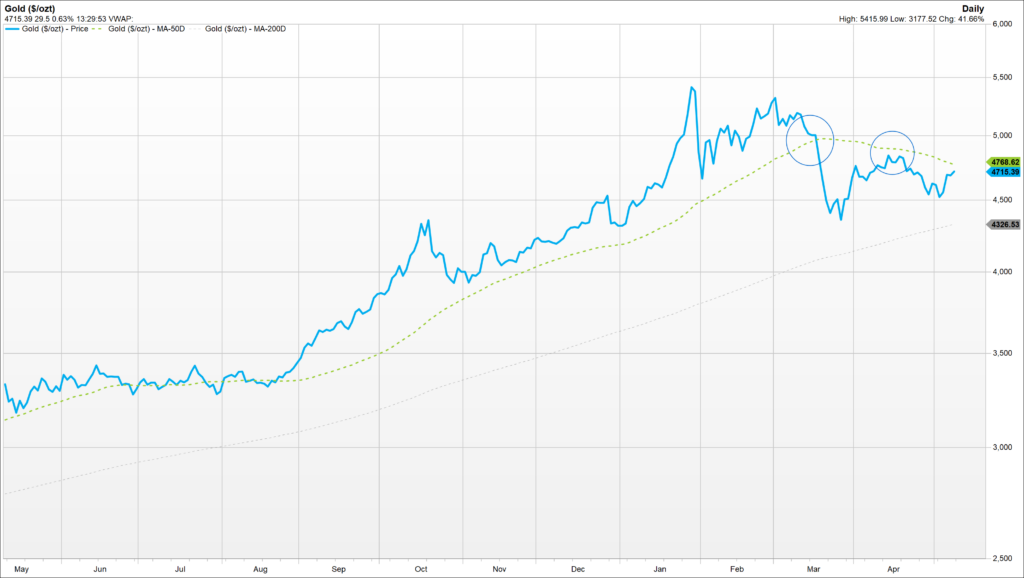
We have often characterized the mood among Gold traders as “sell-the-rally” in the last few weeks, which is confirmed by the above chart, showing the price of Gold for the last 12 months. After the speculative spike in mid-January , the metal has essentially been in a downtrend, which is characterized as lower-highs during its rebounds. The main reason is that there are still a lot of speculative positions “in-the-red”, opened during the explosive rally and which are being closed on the way up, to stop losses. In mid March Gold broke below its 50day moving average (green dotted line), which we have highlighted with a circle and a sell-off took place. Then Gold followed closely the equities’ recovery, but it failed to break back above the 50day moving average, as can be seen by the second circle. During the last few days, as momentum traders are chasing memory chips and Nasdaq higher, traders seem to have returned to Gold as well. Whether the new buying volume will be able to absorb selling is anybody’s guess, but if the technical picture improves selling should also subside, and get back to “buy-the-dip”. A big test lies ahead as it approaches again its resistance line, which currently sits around 4’760$. On the downside, the long-term 200day moving average remains intact (grey dotted line).
Sources : Chart: KSH/FactSet
The content of this document has been produced from publicly available information as well as from internal research and rigorous efforts have been made to verify the accuracy and reasonableness of the hypotheses used. Although unlikely, omissions or errors might however happen.
The data included in this document are based on past performances and do not constitute an indicator or a guarantee of future performances. Performances are not constant over time and can be positive or negative.
This document is intended for informational purposes only and should not be construed as an offer or solicitation for the purchase or sale of any financial instrument and it should not be considered as investment advice. The market valuations, views, and calculations contained herein are estimates only and are subject to change without notice. Any investment decision needs to be discussed with your advisor and cannot be based only on this document.
This document is strictly confidential and should not be distributed further without the explicit consent of Kendra Securities House SA.