Thoughts of the week.
Last Tuesday, the USD government debt surpassed the 40tn $ mark for the first time ever. Interestingly, President Trump had said in 2016 that he could eliminate the national debt within eight years, then being at around 20tn $, half of today’s level. The past year alone it grew by 3tn $ and the Debt/GDP ratio is now almost 120%. The US Government is now spending more than 1tn $ per year in interest payments, which amounts to about 25% of their revenues. To be fair, in those last ten years we experienced a pandemic that happens once in a century and which crumbled the finances of many countries around the globe. But that was almost seven years ago, and things are worsening.
A vicious circle in the US government bond market might have begun. Older bonds, with almost zero interest rates, have been coming due and the US Treasury has been replacing them with much higher interest rates, increasing thus the future interest payments, which will deteriorate further the US government’s deficit and hence even more debt must be issued. The US President has a launched a war which has pushed inflation higher at a time when the economy is firing on all cylinders, leaving no space at all for the FED to cut interest rates. And all this comes at a time when the US government needs foreign creditors more than ever, but these have been turning their back. China, one of the biggest creditors to the US government, now holds less than 600bn$ of US Treasuries, 50% less than a decade ago. Japan has been selling its USD bonds to defend the Japanese Yen sell-off by buying back their own currency. Many Emerging Market Central Banks are diversifying their USD exposure to other currencies such as the Yuan, but also Gold.
The US Treasury’s actions of the last three weeks is just a testament of how the situation has worried them. First, they intervened in the foreign exchange market in coordination with Japan’s authorities to stem the Yen’s precipitous drop … out of “solidarity” to their ally. The truth is that Japan in order to defend the Yen was offloading billions of US government bonds and buying back their currency pushing yields further higher. Then surprisingly on Wednesday, Treasury Secretary Bessent announced that they will double the amount they spend on buying back long-term bonds, because of … lack of liquidity in the market. The truth is that Mr. Bessent, an ex-hedge fund manager, wants to send the message that they are willing to intervene and support the falling bonds. It took the market less than 24 hours to view this as a desperate move and pushed yields higher again.
Financial markets are currently living in two parallel worlds. Equities are zooming higher thanks to extraordinary profitability growth on both sides of the Atlantic and indices have been registering new record highs. Government bonds are continuously losing ground as high inflation, high debt, high budget deficits as well as increasing supply by AI-related borrowers keep bond investors nervous and long-term yields reaching multi-year highs as well. The problem is that eventually these two markets meet and face each other. Higher yields means that corporate borrowing is more expensive, mortgages are more expensive and valuations of companies which are based on discounted cash flows have to move lower as the denominator is increasing.
We have already highlighted that bond yields is the biggest risk for the equity markets going forward. To avoid getting hit on both sides, we have chosen to have no exposure in long-end bonds and primarily be invested in funds which can even go short US Treasuries (i.e. gain when bonds fall) and other government bonds, when the manager deems appropriate. We are also approaching the historically volatile month of September close to record highs for equities and hence some turbulence could lie ahead. But we have not made any major changes in portfolios yet.
Weekly highlights.
The minutes of the last FED meeting were published. They can be characterized rather hawkish and despite the fact that the market has priced out a September hike, it does look that the majority of the voters could be getting close to “push the button”. According to minutes: “Several participants noted price increases were broad based. Some participants noted even after stripping out tariffs and energy, underlying inflation appeared to be elevated. Many participants assessed that policy tightening (rate hikes) would likely be necessary if inflation did not decline“.
The Eurozone Composite PMI rose to 52.1 in August, above consensus of 51.7, driven by stronger manufacturing, where new orders are now at their highest level since March 2022. At the same time, the manufacturing sector is expanding employment for the first time in 3.5 years. The Services PMI remained unchanged at 51.7 , but also better than expected (51.5).
The annual Jackson Hole conference is taking place at the end of this week. Hosted by the FED in beautiful Wyoming with most of the world’s Central Bankers present, the event has several times been market moving, as the incumbent FED Chairman takes the opportunity to pre-announce changes in monetary policy or other significant inflection points. Of course, Chairman Warsh is very opposed to providing any forward guidance even during the official meetings of the FED and hence we do not expect to receive any hint on interest rates. Most probably he will talk about possible changes in the structure of the FED and the way it has been conducting monetary policy , topics which could move markets too.
Markets’ reaction.
Global equities had a negative and volatile week. The momentum trade, which had been revived since mid- July’s sell off, stalled and Nasdaq underperformed with a 2.1% drop, causing the S&P500 to drop by 1.1%. European indices also lost about 1% for the week. Materials (+4.1%), Healthcare (+3.8%) , Energy (+3.0%) outperformed while Technology (-2.8%) and Industrials (-2.7%) found themselves at the bottom of the list.
The bond market was again volatile. The Treasury’s announcements as described above, drove yields lower on Wednesday as the 30yr was breaking above 5.30% and the 10yr was trading north of 4.70%. But the mini-rally did not last long as yields spiked higher again at the end of the week. The 10yr is back around 4.75%. European yields did not move as much, as the events were concentrated around the US government bond market.
Gold rallied, as momentum traders have picked up the trend. The turmoil in US Treasuries has made investors turn to gold again, despite higher yields not being a friend to it. The yellow metal traded above 4’600$, amidst reports that central banks are again active.
The dollar sold off and the EURUSD touched 1.1700 again. Higher yields are normally a tailwind for the US currency, but foreign investors seemed to currently prefer to reduce exposure to US government debt and the dollar all together. In case there is a major crisis with US Treasuries, the dollar will take most of the hit, because the US government will not chose to default. They will chose to debase the currency, by printing trillions.
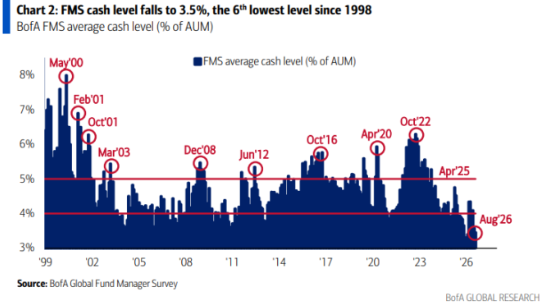
Chart of the week: Fund Managers cash levels fall to 30yr low.
Source: Bank of America
Bank of America publishes a monthly survey of Fund Managers which shows the cash levels and their risk appetite towards equity markets. Currently the percentage of cash in the portfolios of the managers has reached the lowest level since 1998, at 3.5%. This is usually a contrarian indicator as low cash levels means little fire power to invest more in equities. On the contrary, when cash levels are high as is the case during crises and sell-offs then equity markets find their bottom and produce big returns. These points/dates are highlighted in the above chart in red, and as one can see they coincide with inflection points/market bottoms during major events. Although fundamentals for equities remain strong, stretched positioning and leverage could create the conditions for mini corrections, as it happened in mid-July.
The content of this document has been produced from publicly available information as well as from internal research and rigorous efforts have been made to verify the accuracy and reasonableness of the hypotheses used. Although unlikely, omissions or errors might however happen.
The data included in this document are based on past performances and do not constitute an indicator or a guarantee of future performances. Performances are not constant over time and can be positive or negative.
This document is intended for informational purposes only and should not be construed as an offer or solicitation for the purchase or sale of any financial instrument and it should not be considered as investment advice. The market valuations, views, and calculations contained herein are estimates only and are subject to change without notice. Any investment decision needs to be discussed with your advisor and cannot be based only on this document.
This document is strictly confidential and should not be distributed further without the explicit consent of Kendra Securities House SA.