Designed by Tomohiro Nishikado, Space Invaders can be considered the “mother of all video games”. For those of thus who grew up in the late ’70s and early ’80s , arcade games were the first and only contact with Technology. Being adolescents during those offline times, we quickly became fascinated by the arcade booths, initially found only in dodgy cafés, where there was also an age limit to enter and play. This additional adrenaline made these games even more desirable.
That was also a time when the Space Shuttle project was officially launched. The world was still talking about the “Man on the Moon”, although more than a decade had passed. But the images of the Columbia returning from space and landing like a normal airplane at Edwards Air Force Base in Southern California on April 14, 1981 left the world in awe. A few decades later, there is an International Space Station orbiting around earth with continuous human presence and two functional rovers on the surface of Mars, the Curiosity and Perseverance operated by NASA. China has landed its own rover, Zhurong, but it has remained inactive since 2022.
Today, Elon Musk wants to launch orbital data centers, organize regular vacation trips to the moon and send a manned mission to Mars. If you think this is my own exaggeration, you probably have not read the prospectus of the new SpaceX IPO or have not listened to him describing the company’s vision. It is great to have visionary people around us with larger-than-life dreams, because this is how the world has immensely progressed in the last one hundred years. Even Musk himself, now a trillionaire, said on Friday than when he launched the company, almost 20 years ago, he gave it less than 10% probability of success, but he pursued the dream. His company has now a 2tn$ market valuation. Not bad for a lossmaking company which now trades at 100 times last year’s sales. Goldman Sachs projects SpaceX revenues will surge to 322bn$ by 2030 up from just 20bn$ last year, while Morgan Stanley gave investors the “wet dream” : it projects revenues hitting … 3.4tn$ by 2040. (I should mention that both banks were underwriters of the IPO).
In this dream-world, valuations do not matter. Investors want either a quick buck, ride the momentum or to participate in this futuristic world at any price. Owning SpaceX shares or red-hot chip stocks makes you popular at summer cocktail parties. Of course, history has shown that in the real world valuations eventually do matter. This has nothing to do with the success or not of a new theme or technology. Technologies once seen as science-fiction have indeed flourished and conquered our daily lives. But many companies that had promised these technologies have seen their share prices crater afterwards, because they had already discounted the future several times over. Nokia, France Telecom, Infineon, A&T Wireless, the bankrupt Nortel and WorldCom, the market’s new darling Micron Technology which lost 97% of its value in the 2000-2002 bear market, are just a few examples.
This is not to say we are now at 1999. It certainly feels like it, especially with the barrage of ultra hot IPOs that are lined up, but we can safely argue that at the index level we are still far from being at a bubble. The tech-heavy Nasdaq at 26 times forward earnings is just lofty, not excessive. Then again, the Nasdaq-100 index is primarily 10-15 mega caps, weighing almost 60% of the index and are now becoming valued as the “old Tech”. This structural factor has the potential to mask the reality “under the hood”, where excessive valuations are indeed forming. Investors should start being cautious on where they put their chips (pun intended).
The question that begs answering is how to be positioned now. This year, we have chosen to be initially prudent, then very active and opportunistic and now it is best to become a little more boring again. During the March Nasdaq sell-off, it was the time to increase significantly the Tech exposure as everything seemed to be on sale. Based on the the way markets and valuations evolved in the last two months, we decided to trim positions and secure profits, especially in stocks that have risen at levels that are now extrapolating dream scenarios. As high oil prices had brought down European consumer names (luxury, autos etc.) and energy-heavy industries (cement/chemicals) , we cautiously took capital from Tech and increased exposure to those, betting that eventually there will be a peace deal in Iran and they will fly. But a few days ago, we also increased exposure to boring, defensive stocks (staples) which nobody else wants, at a time when the world is talking only about Space.
Bottomline, having been more concentrated in themes like electrification, defense, AI beneficiaries before, we now increased diversification again. This by nature reduces potential future returns, but also secures that our very positive returns until now are partly locked-in. Then again, we are probably not going to make many new friends at this summer’s cocktail parties …
Weekly highlights
US May inflation rose to 4.2% , as expected, up from 3.8% in April. On a monthly basis, the headline CPI rose 0.5%, pushed up by gasoline prices. The core CPI rose 0.2% in May and the 12-month rate moved up from 2.8% in April to 2.9% (2.85% unrounded), again as expected. The markets reacted positively to the numbers as core remained below 3%.
The ECB raised rates by 25bps to 2.25%, as expected. The decision to hike rates was unanimous and, according to the Governing Council, justified by the ECB’s new macro baseline forecasts as well as the three alternative scenarios. We cannot say that today’s hike was a “one and done”, as Mrs. Lagarde also said during the press conference that this is not an “insurance” hike. The market is currently pricing at least one more hike and with a high probability of a third one until year end (45bps are priced in currently) . But the most likely scenario is that the ECB will pause during the July 23rd meeting and reconsider its policy in September.
The FED is meeting on Wednesday. They are actually starting their meeting on Tuesday but on Wednesday they are going to announce their rate decision which will be a Hold, with 100% certainty. This will be the first meeting with newly appointed Kevin Warsh as Chairman and the world will zoom into his press conference for any signs of what will follow until year end. The money market is still pricing a rate hike by December, with a high probability.
OpenAI is about to engage into a pricing war, according to reports. The company is expected to lower prices as competition has been fierce by Anthropic and other platforms. This will be a significant development and while it would be positive for consumers and could lead to further AI adoption, the business plans of these companies will most probably have to be rewritten with lower expected revenues per user.
At the same time, Anthropic was directed by the US government to suspend its latest state-of-the art models. The reason according to the announcement was national security, as the government discovered a “jailbreak” in the system, or in other words a way to bypass safety guardrails built in the model. The company replied that it is unfair to block access only to its own models , and it would be wiser to halt all new model deployments. The company had already suggested that slowdown in a blog posting the previous week, a factor that has not been modeled yet in AI infrastructure beneficiaries analyst projections, and remains a wild card.
Markets’ reaction
Global equities rebounded, with Europe outperforming the US. As we have mentioned before, a potential peace deal and/or the fall in oil prices will primarily benefit European equities as they had been underperforming since the conflict started. And that is what happened last week, as hopes were increasing for a positive outcome. Europe rose by 2% helped primarily by the beaten down consumer stocks , of which we talked last week. The S&P500 and Nasdaq rose by 0.7%, as the rotation out of Tech continued. On the contrary, Russell 2000 had a very positive week (4.8%) and is now +18.5% on a year-to-date basis.
The bond market moved higher. The less-than-feared US inflation data as well as the fall in oil prices caused yields to drop on both sides of the Atlantic. The move was more pronounced in EUR yields despite the rate hike by the ECB, as the market is pricing out an aggressive hiking campaign by the central bank since growth is also impacted by higher oil prices. The German 10yr fell to 2.95%. The US 2yr fell to about 4.10% from a high of 4.20% and the 10yr is back below 4.50%, but the sentiment is still fragile ahead of the FED meeting this week.
Gold dropped close to 4’000$, but rebounded. The psychological level, which we had talked about, was finally touched, and the yellow metal rebounded together with the equity markets when Trump posted about an imminent deal with Iran. It finished the week closer to 4’200$, but the sentiment is still fragile in a traditionally weak season for Gold until the Asian wedding season demand picks up in late fall.
The dollar weakened, as financial markets recovered. The EURUSD rose to 1.1570 and we can assume it can resume its ascend if the oil market normalizes.
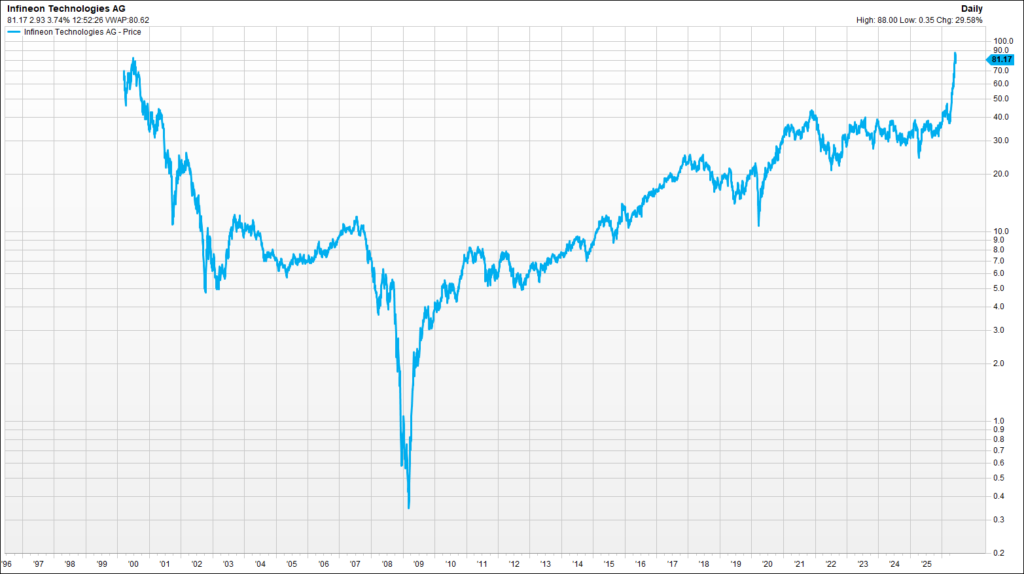
Chart of the week: Remembering the good old days of 1999 …
Source: KSH/FactSet
One of the hottest stocks in the crazy last two months is the European memory chips-maker Infineon Technologies. The stock is already up 100% since March and trading at 45 times this year’s earnings. We had bought the stock for our portfolios in March close to the lows of the year, and we really enjoyed all this rally. But we chose to sell it at the current levels, a few days ago. The specific stock is not a “new stock” for us, as it has a long history. It was one of the IPOs of early 2000 which coincided with the bubble in Technology stocks. A spin-off from Siemens back in the day, it was marketed as a hot IPO at a market value of 22bn€. Demand was so huge that the stock more than doubled on its trading debut to reach a stratospheric valuation (for the times) of 55bn€ with just 70mn€ of annual profits. What happened next can be seen in this very long-term chart. At first it lost 90% of its value and during the 2008 crisis it almost went to zero, reaching a valuation less than 1bn€. The price is now back where it was in 2000, after the recent huge rally. At least after 26 years the initial investors got their money back !!
The content of this document has been produced from publicly available information as well as from internal research and rigorous efforts have been made to verify the accuracy and reasonableness of the hypotheses used. Although unlikely, omissions or errors might however happen.
The data included in this document are based on past performances and do not constitute an indicator or a guarantee of future performances. Performances are not constant over time and can be positive or negative.
This document is intended for informational purposes only and should not be construed as an offer or solicitation for the purchase or sale of any financial instrument and it should not be considered as investment advice. The market valuations, views, and calculations contained herein are estimates only and are subject to change without notice. Any investment decision needs to be discussed with your advisor and cannot be based only on this document.
This document is strictly confidential and should not be distributed further without the explicit consent of Kendra Securities House SA.