Thoughts of the Week.
Back during the Covid days, we had written in our weekly newsletter that the world is starting to look a lot like the 1920s. We had even dared to dub the emerging new decade the “new roaring ’20s”, a term which was coined in the previous century, to describe an era of remarkable economic growth, social transformation, technological innovation, but also financial speculation in the United States. The analogy started of course with the pandemic that had hit humanity in 2020, almost exactly 100 years after the previous deadliest pandemic, the Spanish flu in 1918-1920. Our argument back then was that when this is all over the world will probably indulge into extreme consumerism, economic growth will explode and technological advances will accelerate.
American life changed dramatically in the 1920s,. This period saw the first trans-Atlantic phone call, the first movie with sound, the first mass-produced car at popular prices, and the discovery of penicillin among other medical achievements. The use of radio became widespread in households, the idea of television was conceived and the first commercial flights turned from fantasy to reality. The first official airport terminal in the U.S. was the Ford Airport in Dearborn, Michigan, in 1927. Urbanization accelerated, as more Americans moved from rural areas to cities in search of opportunities.
The decade is also known for the remarkable multi-year rally in the stock market, followed by the crash of 1929, which led to a deep depression. As the economy had started to heal from the consecutive recessions casued by WWI and the pandemic, the Dow Jones found itself in a strong bull market during the period 1920-1925, but with no visible signs of excess valuations or behavior. In 1926 the market was flat and in 1927 stock prices accelerated dramatically, as margin buying became widespread and investors borrowed heavily against their portfolios.
By late summer 1929, the Dow Jones had quadrupled since the turn of the decade. In August of that year the FED decided to turn more restrictive, raising rates from 5% to 6%, in response to the stock market excess. Equity prices started to slip and fell about 10% from their high. This period looked like a standard correction but selling pressure escalated on Thursday 24 October 1929, when panic hit the NYSE and around 13 million shares changed hands versus a prior average of about 4 million. Ticker tapes fell far behind real‑time trading, leaving many investors uncertain about prices as they watched their paper-wealth evaporate. A syndicate of bankers stepped in that day to support prices, which produced a temporary stabilization, but confidence was already badly shaken. The real break came the following week. On Monday 28 October, the Dow fell nearly 13%, and on Tuesday 29 October it dropped almost another 12%. Over the next few years, equities continued to fall. By mid‑1932, U.S. stocks were worth only about one‑fifth of their summer 1929 value, representing more than a 80% peak‑to‑trough drawdown. It was during these years that swapping regulatory changes took place in the banking sector. The most disruptive event was The House of Morgan which had to split in two, with partners Henry S. Morgan (grandson of John Pierpont Morgan Sr.) and Harold Stanley creating the investment banking giant, while JP Morgan Jr. kept the commercial business unit.
Six years into the 2020s, we can still find many analogies. The pandemic was followed by extreme consumerism, as we had forecast back in the day. That was a time when valuations of luxury goods companies where more expensive that fast-growing Tech names and alcoholic beverage companies’ shares were breaking one record higher after the other. Consumer prices kept moving higher (inflation) as demand outpaced supply which was seriously impacted by lockdowns and production/transport bottlenecks but nobody cared, as investors were still trading meme-stocks and work-from-home beneficiaries, in ecstasy. The resulting big correction in 2022 was a necessary reset, before the AI revolution then swept the world, much like the great innovations and technological advances of the 1920s.
Interestingly, in the 1920s there was also a year of (minor) correction early in the decade (1923) before the multi-year rally took place. And as already mentioned 1926 was a rather flat year, so it would be interesting to see how this year will end with the S&P500 up about 10% until now. Lastly financial speculation has also increased dramatically over the last years, just as in the 1920s, and especially right after the pandemic when meme-stocks, zero-day options and social-media viral trading tips have flourished.
One hundred years later we could have history repeating itself. The party should eventually evolve into a bubble that will burst. Whether it is like the 1920s or 1999 does not really make any difference. But, most probably, this is not happening now, so you can still enjoy the summer vacations. Although some specific stocks and sectors have risen parabolically in the last two months, the overall market is far from being considered ultra expensive, as long as the ever- increasing earnings expectations are being met and as long as relentless capital spending on AI is feeding the “animal spirits”. But there is a probable scenario where in the next 1-2 years the market realizes that the trillions spent on infrastructure have not finally produced the necessary ROI. By that time the market would have gotten into stratospheric valuations, will collapse and will destroy investors that went “all-in” late in the cycle. Until then, we are really enjoying the party and looking forward to the summer that it is just about the corner !
Weekly highlights
In the US, April PCE Deflator rose to 3.8% impacted by the ongoing increases in energy prices, but a touch lower than feared (3.9%). Core PCE prices, which exclude energy, rose by 3.3%, as expected. As a reminder, this is the FED’s inflation metric on which it has a target to be around 2%. It is obvious that even without the high energy prices inflation is around 3% and the discussion about rate cuts is most certainly over. Last week’s remarks from Governor Waller, Vice Chair Jefferson, and Governor Cook are all consistent with rates remaining on hold, while there are already voices for a potential rate hike in the summer or early fall.
Eurozone’s May inflation is due tomorrow. It is expected to have risen to 3.3% and core inflation to 2.4%, but a positive surprise is definitely probable, as some country publications on Friday were better than expected. France’s May CPI rose by 2.8% compared to 2.5% rise in April, but slightly below consensus (2.9%). According to the report, the rise was driven by gas prices while those of petroleum products decreased, as well as the prices of food, particularly those of fresh products. In Germany, inflation surprised to the downside falling 0.2pp to 2.7%. As expected, a temporary cut in the fuel tax led to a drop in fuel prices, contributing to the decline in headline. However, the main reason behind the downside surprise was a drop in food prices.
SpaceX filed a preliminary Form S-1 with the SEC to go public. Aiming for a $75 billion raise, it is positioned to be the largest IPO in financial history at an expected valuation exceeding $2 trillion. Musk will retain 85.1% of voting power through super-voting shares and has installed strict corporate governance limits on shareholder lawsuits. The prospectus revealed steep cash burn and surging losses as the company pivots to massive AI investments and Starship development. The company is reportedly targeting its trading debut as early as this month.
Markets’ reaction
Global equities continued their ascend. The S&P500 registered its 9th consecutive positive week , the best streak since 2023 and is now 20% higher from the recent low, propelled by Nasdaq’s 2.5% weekly gain. Europe gained about 1% on average, despite the steep fall in oil prices. On a negative side, the recent strength in the US has been achieved with shrinking breadth, i.e. less stocks participating on the upside, which usually means that a period of consolidation/minor correction is ahead.
The bond market rallied , with the US 10 yr falling to 4.45% and the German equivalent dropping to 2.95%. The market is now pricing a 50% probability that the FED will raise interest rates while in the Eurozone two hikes are now priced in vs three a few days ago. Bottomline is that rate hikes are most probably coming either because of inflation or because of stronger than expected growth.
Gold had a very positive technical test. During its mini sell off it briefly broke below its 200-day moving average falling as low as 4360$ only to rebound strongly to finish the week at 4550$.
The dollar was weaker, in line with the downtrend when oil prices fall and bond yields drop. The EURUSD finished the week at 1.1660.
Chart of the week: The S&P500 is facing resistance ahead.
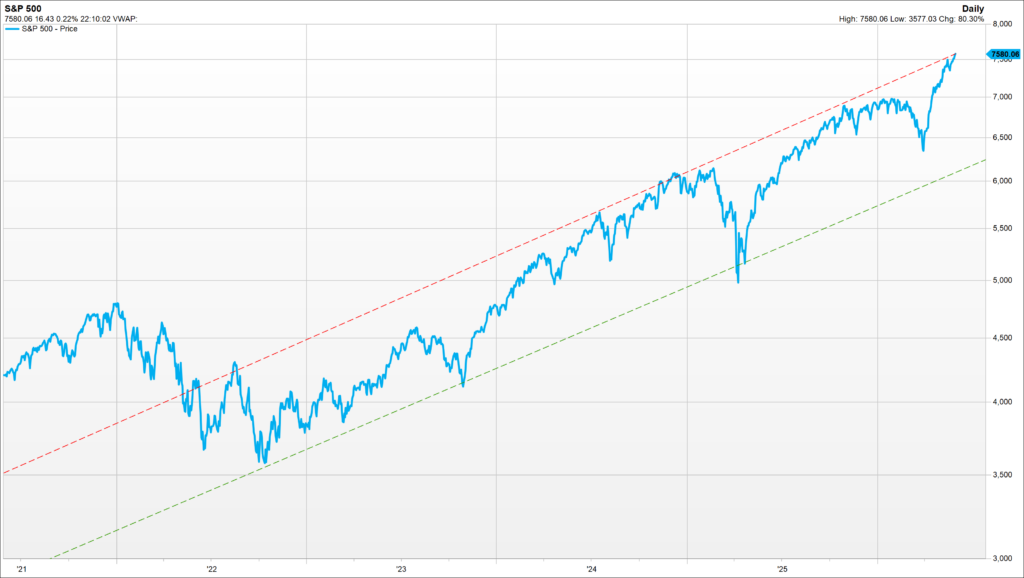
The above chart shows the S&P500 since the sharp correction of 2022. The index has been on a clear uptrend channel, albeit volatile, with all corrections finding support and all rallies finding resistance on the trend lines. The recent explosive run of the last two months has now brought the index right on resistance again. Given also the fact that summer can be volatile, one can assume that the relentless rally should probably pause and a phase of consolidation might be in the cards. On the other side, if we are entering into a crazy party mode, the break of the resistance is probable and would make the move accelerate fast and explosive to meet the next resistance which is much higher, north of 8500 and closer to 9000. These levels correspond to a longer term trendline (not shown in this chart). The FED’s decisions in the summer as well as Q2 earnings (stating mid-July) will determine whether we go straight to 9000 or fall towards 6700-7000 again.
Sources : Chart:
The content of this document has been produced from publicly available information as well as from internal research and rigorous efforts have been made to verify the accuracy and reasonableness of the hypotheses used. Although unlikely, omissions or errors might however happen.
The data included in this document are based on past performances and do not constitute an indicator or a guarantee of future performances. Performances are not constant over time and can be positive or negative.
This document is intended for informational purposes only and should not be construed as an offer or solicitation for the purchase or sale of any financial instrument and it should not be considered as investment advice. The market valuations, views, and calculations contained herein are estimates only and are subject to change without notice. Any investment decision needs to be discussed with your advisor and cannot be based only on this document.
This document is strictly confidential and should not be distributed further without the explicit consent of Kendra Securities House SA.