Thoughts of the week.
This year I am challenging the cliché “you can’t teach an old dog new tricks”. For a generation that has memory of black and white television with two available channels, using fax to send professional messages and opening a 100+ page guidebook to drive to your destination, having AI landing so abruptly on your lap is rather a shock. We proud ourselves to be the generation that had to quickly switch gears in order to adapt to the internet, the mobile phones and be convinced to store our data in a … cloud. And we thought that we had “suffered” enough sweeping changes, on our way to a smooth retirement. But Mr. Altman and Mr. Amodei had other plans.
AI is not new of course. Machine Learning Models have been around for more than a decade, but they were meant to be useful for a handful of people around the globe. Now, they are introduced to us, normal people. There is always some initial doubt and natural resistance, but in our case this did not last long. We have now immersed ourselves in AI with the passion and the drive to create new investment tools , automate our processes and render our everyday work more efficient, for the benefit of our end clients. It is no coincidence that I decided to title today’s newsletter as “Perplexity“, which is one of the AI platforms we are currently using. I even told my “new friend” to create the image for me, being bored to search the web for a corresponding cover pic. Rest assured, I will keep writing the text (… for now).
But the real reason of the cover title is not the marketing of an AI platform. According to Cambridge Dictionary, perplexity is the state of being confused, because something is difficult to understand or solve. And this colorfully describes the current situation in financial markets where divergent forces of different potential market outcomes compete on a daily basis. On one hand, the AI revolution is fueling the growth of companies that provide the necessary infrastructure (data centers) and has supercharged their expected profits for the years to come. On the other hand, governments and central banks are facing multiple challenges such as high fiscal deficits, increased spending on servicing their high debts and high inflation, not to mention political developments ahead, due to a series of upcoming elections.
Investors believe that the AI theme can remain intact independent of what is going on in the bond markets. We beg to differ. If the bond markets crack, chaos will erupt. With this in mind, we cannot underestimate the risks of a blowout in global yields driven by uncontrolled inflation , fiscal frivolousness and already unsustainable debt levels which are serviced at ever increasing interest rates. To make matters even more … perplexed, a Super El Niño weather phenomenon is expected to occur in the coming months, which could dramatically affect agriculture, among other sectors and which could lead to food price spikes hurting inflation even more.
The situation is getting more challenging as the equity market is increasingly focusing on a handful of companies and a large part of sectors are suffering outflows and short selling. In trying to apply hedges or invest according to the above-described complex environment , we face against us the majority of traders and hedge funds who only consider momentum trades and what works now, not tomorrow. It seems easy to invest in just those few, AI-related companies and ignore everything else , just like the majority of investors/traders currently do.
But at KSH we do not really settle for the easy staff. Being alert and active is our fiduciary obligation when managing client money. Having profited significantly from the “explosion” of some of the abovementioned stocks we reduced positions in early July, primarily in memory chip stocks whose revenues have skyrocketed, primarily due to price increase and not volume increase. Revenue growth based on price is never sustainable. This proved prudent as some of these have corrected more than 40% from their peak. Recently we raised cash in our portfolios and we have weathered the September correction rather well, in relative terms. But last week , we took the opportunity to slightly increase our AI exposure again, through the addition of Italian cable company, Prysmian in our High Conviction portfolio. At the same time, to avoid increasing market exposure at possibly the wrong time, we also bought Novartis, which has returned to more attractive levels again and could act as a hedge.
There will be a time when the AI theme will crack. This is not because people like us will stop using AI. On the contrary, it will crack because the majority of the people around the world will embrace AI in their everyday personal and professional lives, which means that competition will skyrocket and its cost will collapse, leaving huge losses behind for those companies who invested trillions to receive billions. It could also collapse if governments decide to act, regulate and slow down the further development because of fear or angst among the voters, who see their utility bills skyrocketing and their land being taken over. Although AI is here to stay, the associated investment theme/mania will come and go, as history suggests and one should be alert, as rotations to other sectors could be violent.
If by now, you are more confused than ever, you have every right to be so. Perhaps we should stop thinking too much and avoid perplexity (the state of mind , not the AI platform).
Weekly highlights.
The FED raised interest rates by 25bp, as widely expected. Chapeau to Mr. Warsh who managed to accomplish a 12-0 unanimous vote at a time when the central bank’s governors were very divided and President Trump was breathing down his neck to cut rates. But the new Chairman showed the world that he perfectly understands the message that must be sent : inflation must be contained at any cost. It is no surprise that the long-end bonds rallied after the decision to raise rates and his hawkish press conference, as the bank’s credibility has been restored for now.
Von Der Leyen’s State of the Union address yesterday marked a hawkish shift in rhetoric towards China. The Commission President warned that the trade deficit has reached a “tipping point” and reiterated that the EU would use “all the tools at [its] disposal” to rebalance the relationship. Germany, traditionally more liberal on trade, appears to be warming up to a harder line as well. With the rise of populist parties like the AfD, protecting manufacturing jobs is becoming an increasingly important political priority. Such a shift in focus could result towards more explicit trade measures and larger industrial policy support, which could have important implication on European sector performance in the next months, favoring laggards such as Autos, Chemicals, Renewable Equipment and Steel.
Markets’ reaction.
Global equities lost further ground, but they improved towards the end of the week. With the help of Technology (+1%), Nasdaq managed to post gains (+0.3%) for the week, while the S&P500 was marginally higher (+0.1%). Europe on the contrary continued to be under pressure, with the Euro Stoxx50 losing 1.5%, but the UK and the Swiss markets managed to stay flat for the week. European broad indices remain about 5% lower from their summer highs. Japan was down 2% last week, while Hang Seng managed to eke out a small gain (+0.3%).
The bond market was volatile after the FED meeting. The 10yr US Treasury reached a high of 5.05% before dropping like a stone to 4.93% and then spiking again, to end the week at 5%. The 10yr German Bund yield stayed above 3.50%, which is the highest since the Eurozone crisis in 2011.
Gold fell below 4’300$ but recovered on Friday to approach 4’400$ again. The yields volatility and the wild moves in the dollar during this “Fed week” spilled into the yellow metal as expected, only to finish almost unchanged for the week, after a lot of sharp up and down daily moves.
The dollar rallied against most major currencies. The EURUSD fell to a low of 1.1450 as the market was pricing more rate hikes by the Fed until year end. It ended the week trading just below 1.1500 as EUR yields rose back to their recent highs.
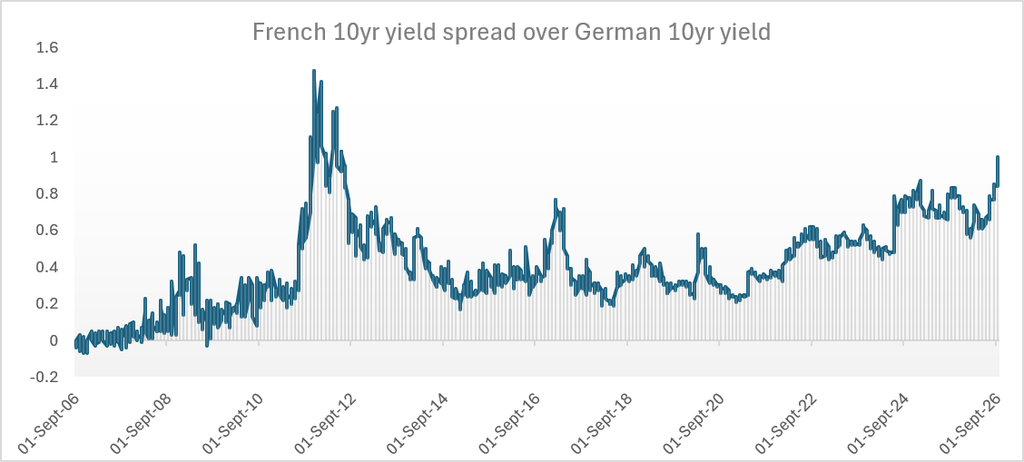
Chart of the week: Here we go again.
Source: KSH / FactSet
On Friday, the bond market decided to focus on France and the Eurozone again, as elections are coming up and debt/deficits are still high. The spread of the French 10yr bond vs the 10yr German equivalent rose to 100bp or 1%, the highest level since the Eurozone crisis in 2011/2012, when it reached a historic high of 150bp or 1.5%. It is interesting to see the history of French vs German bonds, in the above chart, which dates back to the good old years of the early 2000s. Until 2008, the spread was sitting under 15 bps which means that France traded almost like a core/benchmark sovereign alongside Germany. During the Global financial crisis (2008–2009), it jumped to 50-60 bps as investors began pricing credit quality differentiation. As already mentioned, during the Eurozone crisis the spread spiked to a record 150bp, but then the ECB’s Quantitative Easing policy and its aggressive bond buying program squeezed the spread down into the 30-50 bps range again. The covid crisis which led to a huge increase in government spending and hence to a worse fiscal deficit caused the spread to start moving higher again. Then the political chaos caused by Macron’s snap elections made matters worse, with the spread moving into the 60-80bp range. The rise of the extreme left’s and extreme right’s popularity in recent polls has freaked out investors again with the spread now sitting at levels that remind us of the Eurozone crisis.
The content of this document has been produced from publicly available information as well as from internal research and rigorous efforts have been made to verify the accuracy and reasonableness of the hypotheses used. Although unlikely, omissions or errors might however happen.
The data included in this document are based on past performances and do not constitute an indicator or a guarantee of future performances. Performances are not constant over time and can be positive or negative.
This document is intended for informational purposes only and should not be construed as an offer or solicitation for the purchase or sale of any financial instrument and it should not be considered as investment advice. The market valuations, views, and calculations contained herein are estimates only and are subject to change without notice. Any investment decision needs to be discussed with your advisor and cannot be based only on this document.
This document is strictly confidential and should not be distributed further without the explicit consent of Kendra Securities House SA.