Thoughts of the week.
In the previous months we must have sounded like broken records. In early spring, we had highlighted the risk of volatility in the bond market, primarily due to the Iran military conflict but also thanks to the new FED Chairman who brings with him uncertainty. And during summer we had expressed the view that yields are expected to rise even further as the bond market is not only focusing on its own enemy (i.e. inflation) but also increasingly on government deficits and politics/elections. It was again two weeks ago when we discussed about the potential further weakness of government bonds which could spill into equities as well. Our fears for higher yields have now been validated.
Last week, the “snowball” gathered pace and yields reached the highest level in the last 20 years, causing pain to portfolios, as both bonds and equities moved in tandem, reminiscent of 2022. Since mid-August the S&P500 is down about 3% and Nasdaq has lost about 4%. In Europe, the Stoxx 600 index is down about 4% from its mid-August high. Both the 10yr US Treasury and the 10yr Bund yields are up about 40bp in the same short period, which translates to an approximate 3% price drop. It is easy to see how a balanced investment portfolio (50%-50%) with long duration exposure in bonds could have easily lost 2-3% in just the last two-three weeks.
The question which now arises is whether we have seen the worst. All other things being equal, the fate of the equity market now relies almost exclusively on whether the bond market rebounds or not. Market participants have highlighted the importance of a 5% yield for the US Treasury bond, often characterizing it as the “line in the sand”. There is no crystal ball which can show whether this major support will hold or we will soon start seeing levels even past 5.25%, which would crater the stock market. If Friday’s action is any guide, the moment that the 10yr touched 4.99% billions of dollars on the buy side appeared, in a sign that there could be intervention by the US government.
What will it take for the bond market to stabilize ? The obvious response is a complete withdrawal of the US army from Iran’s territory which will make oil prices collapse towards 70$ and perhaps lower. As the situation is right now, global economic growth outlook still looks and corporate earnings are solid. Had it not been for the war in Iran we might have already been past the 8’000 level for the S&P500 and it is also remarkable that we have not lost too much ground from the recent highs, despite long-term yields having risen almost one full percentage point since the end of last year.
Bonds will also rally if there are sudden signs that economic growth is finally been affected by higher consumer prices and higher interest rates. This scenario will look like 2011. Back then, the ECB started raising rates by 25bp in April and July as higher energy and commodity prices had lifted inflation expectations, but the economic background had already started deteriorating. The central bank then had to reverse both increases in November and December of the same year, as financial stress intensified, confidence deteriorated and the growth outlook weakened. In this scenario, the bond market will rally but equities will correct rather significantly.
All in all, the situation calls for cautiousness but offers some optimism that we might have seen the worst. Long duration bonds have finally improved their risk-return profile, but getting back into them entails the risk of getting hit on both sides (bonds and equities) if inflation continues to be a problem. Buying short-end (2-3 years) high quality bonds at current levels is however tempting , when EUR yields are almost 4% and the USD equivalents are approaching 6%.
Weekly highlights.
The ECB raised interest rates by 25bp , as expected. In the press conference that followed, Mrs. Lagarde called it “a no brainer,” and confirmed that the decision was unanimous, describing it as “robust” against all three of the ECB’s inflation scenarios for the region — benign, adverse, and severe. She was also explicit that the discussion was focused entirely on the current decision and that the Governing Council had not debated any future path, taking thus no view on the direction of the next meeting. The market decided to ignore her anyway, betting that the central bank will continue raising rates this year.
August US inflation was a bit worse than expected on the core side, which excludes energy and food. It rose by 0.3% for the month and by 2.4% on an annual basis. The headline number was published at 3.4% annualized, 0.1% higher than July’s figure. The FED meeting on Wednesday will be very interesting to watch, with the probability of a rate hike now sitting at more then 65%.
The US Treasury department said that it would purchase $6bn in government debt, in the first buyback operation since Scott Bessent unveiled the expanded scheme last month to arrest a rise in borrowing costs. The new figure is a step-up compared with Treasury’s vow to “at least” double its purchases of long-term bonds to $4bn from the previous 2bn$. The market saw this again as a desperate move and send yields even higher, before retreating on Friday.
Artificial Intelligence news made again headlines. It all started when Anthropic researcher Jacob Coxon set off a firestorm over AI safety and existential risk. When he resigned last Tuesday, he argued that his employer and its rivals were “gambling with our lives” by racing to develop a super-intelligent AI that was capable of improving itself faster than human oversight could keep up. Then, in an essay published on Saturday, Anthropic’s founder Amodei said the tech industry “must slow the pace at which we improve the capabilities of AI models”, after the speed of development became “drastically faster” this summer. Sam Altman (OpenAI) and Elon Musk were quick to publicly support Amodei’s call to slow AI’s development.
President Trump offered a 5’000$ check to all adult Americans if Republicans win the midterm elections. The probability of this going ahead is close to zero not only because Congressional approval is needed and already Republican members of Congress have publicly criticized it, but because it will also blow out the already ballooning fiscal deficit, at a time when the 10yr yield is knocking on 5%’s door.
Markets’ reaction.
Global equities were rather mixed. Thanks to a late Friday rally US equities managed to finish the week marginally higher , with Nasdaq up 0.4% and the S&P500 +0.1%. Europe on the other hand was under pressure, as both the momentum trades (Technology -1.5%, Industrials -3%) and the rest of the market (Discretionary -2.8%, Utilities -2.5%) were weak. Energy and Financials provided some cushion.
The bond market was again under pressure, as also mentioned before. Yields were about to break out from significant levels (10yr at 5.0%) and surprisingly the market recovered after the slightly worse than expected core CPI was published on Friday. It does look like the US Treasury might have intervened in the market, as US Treasury Secretary Bessent had warned the market not to bet against them : “I am the house now” he explicitly said, making reference to casino-type operations.
Gold fell closer to 4’300$, as yields were moving higher but managed to rebound to 4’350$ at the end of the week. Gold’s fate depends on the bond yields (negatively correlated) but because there is also the underlying themes of inflation, fiscal deficits and potential debasement of the dollar, it should be supported for now.
The dollar did not move much. The EURUSD remained around 1.1600, as the ECB’s rate hike could be rivalled by a FED move this week keeping traders nervous about what happens next.
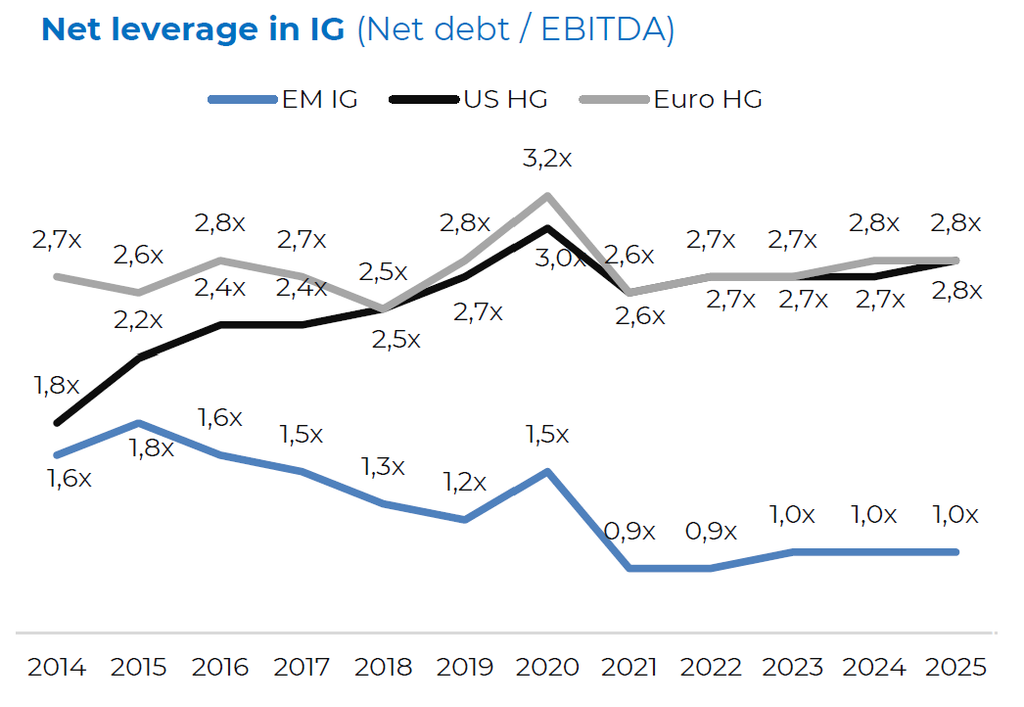
Chart of the week: Emerging Market Bonds are safer than the rest of the world.
Source: IVO Capital
The above chart shows the Net debt/ EBITDA ratio for Investment Grade bonds in Emerging Markets (dark blue line), Europe (gray line) and the US (black line). So that our readers understand, net debt is the amount of debt that would remain after a company had paid off as much debt as possible with its liquid assets. On the denominator, EBITDA is earnings before interest, taxes, depreciation and amortization. Hence the Net debt/ EBITDA is a metric of the company’s ability to repay its debt according to its cash flow, and the lower this ratio is the better is for the company’s balance sheet. Any value below 3 is considered a safe margin, while values closer to 1 are usually for top quality companies. As we can see in the above chart Emerging Market companies have relatively very low debt levels, while the US and Europe are closer to the “borderline” 3% (we are talking about the Investment Grade bonds, i.e. those rates BBB- and above). As a reference, the EM High Yield bonds (rated BB and lower) not shown in the above chart, have a lower ratio (currently at 2.7) than the US and European Investment Grade peers … Of course, political and geopolitical risks are higher in the countries these companies operate and hence they carry a significant spread over US government bonds. Given this spread , EM bonds offer substantial yield pick up (currently at around 7.5-8.0% in USD) with a much better credit profile than their peers. The recent rise in yields perhaps provides a good entry point again.
The content of this document has been produced from publicly available information as well as from internal research and rigorous efforts have been made to verify the accuracy and reasonableness of the hypotheses used. Although unlikely, omissions or errors might however happen.
The data included in this document are based on past performances and do not constitute an indicator or a guarantee of future performances. Performances are not constant over time and can be positive or negative.
This document is intended for informational purposes only and should not be construed as an offer or solicitation for the purchase or sale of any financial instrument and it should not be considered as investment advice. The market valuations, views, and calculations contained herein are estimates only and are subject to change without notice. Any investment decision needs to be discussed with your advisor and cannot be based only on this document.
This document is strictly confidential and should not be distributed further without the explicit consent of Kendra Securities House SA.