Thoughts of the week.
Equity markets do not operate in a vacuum. The investment world (including ourselves) are fixated on the AI revolution which has completely altered the multi-year revenue growth for companies related to the vast buildout of infrastructure. However, corporations operate in a macroeconomic and political environment, whose variables are in a continuous flux. Governments determine how much money and where money will flow in the economy, which sectors will benefit, how friendly the tax and regulatory regimes will be, but they also have to take care of their own accounts at the end of the year. This is usually referred to as fiscal policy. Governments also have to finance their budget deficits (spending more than earning), which means that the long-term interest rates they are paying on their loans will be determined by the markets. This interest rate is not only affected by the willingness of creditors to lend money to a government but will also be determined by how well the country’s inflation has been controlled, which is not the work of the government but that of the central bank. This is usually referred to as monetary policy. In periods of high inflation the central bank will be raising short-term rates, which will have an impact on the borrowing cost of their own governments, which in turn affects their budgets. In conclusion, interest rates always have an impact not only on economic growth but also on corporate profits and valuations and hence government policies can make the difference (positive or negative) in any country’s stock market.
Governments are (… usually) elected. And the majority of the voters do not really understand the above- described complex relations, let alone care if the stock market will rally or crash. Even in the US, where a large majority of the residents’ wealth is tied to the stock market (58% of households own stocks), the average voter will primarily care for their daily needs and cannot look past the next month’s bills. According to Federal Reserve data only the wealthiest 1% of Americans own 50% of all household equities, while the top 10% collectively control roughly 90% to 93% of the total value of the U.S. stock market. At the same time, just 28% of households earning less than $50,000 per year own stocks. And those earning below $50’000 are almost one third of the households or about 40 million. The point is that when the election day comes a large part of the population neither understands nor cares about the stock market.
The situation is worse in Europe. While there are no aggregate data, the average stock ownership could be estimated to about 20%. The Nordics are an exception, where countries like Sweden and Finland have stock market participation rates equivalent to the US (i.e. more than 50%) In France and the Netherlands stock participation is closer to 30%, while Germany and Italy have historically low retail stock ownership of not more than 20%. The positive side of course is that there is room for potentially significant increase of flows into the regional stock markets, but then again these flows will be determined by politics and the macroeconomic environment.
It is obvious that politics have in the past and will always determine the faith of the stock markets. The mere fact that European equities have been trading at deep valuation discounts vs their US peers for the last twenty years and especially since the 2011 Eurozone crisis is the by-product of the vast difference between Europe’s and US governmental policies. As we are getting closer to the new year, investors should start thinking of the important elections coming up in Europe. In France, Emmanuel Macron must leave the Elysée Palace by spring 2027 and the polls show that the final vote could be between the far left ( Mélenchon) and the far right (Marine Le Pen). Spain faces a national vote due by August 2027 which will determine whether the Prime Minister Pedro Sánchez’s fragile coalition can hang on to power. Italy follows later in the year, with a general election due by December 2027.
But we have elections coming up very soon too. In Germany, elections for the regional state parliaments will be held in Saxony-Anhalt next week, while Mecklenburg-Vorpommern and Berlin will be held both on 20 September. All are located in the eastern part of Germany, where the far-right AfD tends to have more support. Opinion polls point to large vote increases for the AfD and in Saxony-Anhalt the party is close to an absolute majority with 42%. If the AfD obtains an absolute majority, the party would be able to hold the office of prime minister for the first time in a German state. Then we have the mid-term elections in the US in early November, which determine whether the Republicans will maintain control of both parts of Congress or the Democrats can win back the Senate. In the Senate, thirty five seats are up for election out of the one hundred and Democrats need to “flip” just four seats. . This will create a new political environment for Trump, whose hands will finally be tied compared to the one-man show we have been watching since January 2025.
In conclusion, politics, fiscal or monetary policy errors can break the markets. I have described in the first paragraph, in a simplistic manner, what fiscal and monetary policies mean. For those who believe that only France and parts of Europe are in trouble, I will offer a different view. Even a multi-year mega trend such as the AI revolution will not save the markets if the US government does not tackle its deficits and the central bank does not bring inflation back to lower levels in a sustainable way. With a new FED Chairman in charge and midterm elections coming up, we are entering a tricky period.
Weekly highlights.
The FED Chairman’s Jackson Hole speech proved to more hawkish than expected. Kevin Warsh surprised the markets with the message he chose to convey, as he clearly pointed to rate hikes being a very live option for the coming meetings. “Here is my standard: we must be confident that underlying inflation is moving to our objective, clearly and at sufficient speed. Otherwise, we have work to do” were his exact words. At the same time he said that the labor market looks robust which puts the emphasis on price stability (i.e. inflation) , while he also said that “the FED has missed the 2% target for 65 months” and without any progress soon they will have to raise rates.
US July PCE index remained at 3.70%, slightly higher than expected. The core PCE price inflation, which excludes food and energy also remained unchanged at 3.30%, although if we add a decimal it actually rose from 3.29% last month to 3.34%. As a reminder, this the inflation metric that the FED targets and not the CPI. We should note that next month’s release of PCE prices for August will incorporate methodological changes, which could mechanically lower inflation by 0.2%-0.3%.
Eurozone CPI inflation data are out tomorrow, Tuesday. It is expected to have risen to 3.2% from 2.9% the previous month, as oil priced moved higher in August. On Friday, France published its own numbers which printed at 2.7%, up from 2.5% in July.
Markets’ reaction.
Global equities rebounded mildly, albeit in a volatile manner. The sharp rotations in style both in the US and Europe, which now happen on a daily basis, keep broad indices almost unchanged lately, while Technology continues to play the dominant role in the S&P500’s performance, which posted a 0.5% weekly gain. But eight out of eleven sectors of the index finished negative for the week, and small caps (Russell 2000) dropped 1.5%. Europe was a mixed bag, as French equities were under “attack” in the middle of the week and the momentum trade was on/off for the duration of the week. The EuroStoxx 50 managed to eke out a small gain (+0.4%) while Germany outperformed (+1.7%), which is typical when there is some trouble in southern European countries.
The bond market was in focus again. USD yields rose after Warsh’s speech while the curve steepened as the short-end yields rose more than the long-end. The 2yr yield traded again at 4.35% up more than 10bp for the day on Friday, while the 10yr broke above 4.70% again. In Europe, as already mentioned, the French yields rose to levels last seen during the 2025 crisis and the 10yr Bund rose to almost 3.30%.
Gold sold off on Friday, after the yields rose. As mentioned several times, higher yields and higher dollar are not its best friends and the yellow metal fell to 4’450$ as traders wanted to lock in recent profits ahead of the weekend.
The dollar rallied hard, against most major currencies. The EURUSD fell to 1.1580, as the market was clearly not prepared for a hawkish speech by the FED’s Chairman.
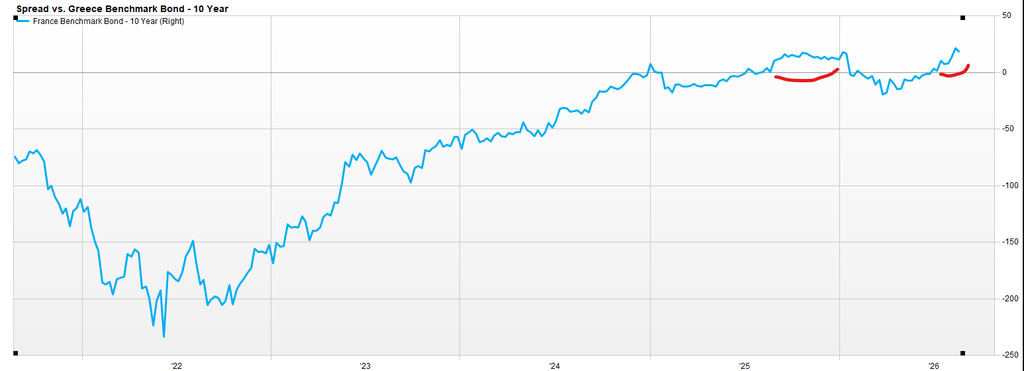
Chart of the week: French Government bonds have now higher yields than Greek.
Source: KSH / FactSet
The above chart shows the spread of the French Government 10yr bond vs the equivalent of Greece for the last 5 years. In “normal” circumstances the French government bond had always had a deeply negative spread with Greece as seen on the left side of the chart, meaning that Greece was borrowing at a much higher rate than France. Fast forward to the last two years and things have changed dramatically. The significant improvement of the Greek fiscal situation and the worsening of the French at the same time, has made this spread not only disappear but turn positive during times of mini crises. The first time was when President Macron called for general elections in the summer of 2025 (highlighted in red) , sparking a sell off in his country’s debt. In recent weeks and as we are approaching the 2027 presidential elections, the spread has become positive again (i.e. France’s yields are higher than Greece’s) as local polls show that the extreme left and the extreme right could win the presidency. Of course, Greece has its own elections next year too …
The content of this document has been produced from publicly available information as well as from internal research and rigorous efforts have been made to verify the accuracy and reasonableness of the hypotheses used. Although unlikely, omissions or errors might however happen.
The data included in this document are based on past performances and do not constitute an indicator or a guarantee of future performances. Performances are not constant over time and can be positive or negative.
This document is intended for informational purposes only and should not be construed as an offer or solicitation for the purchase or sale of any financial instrument and it should not be considered as investment advice. The market valuations, views, and calculations contained herein are estimates only and are subject to change without notice. Any investment decision needs to be discussed with your advisor and cannot be based only on this document.
This document is strictly confidential and should not be distributed further without the explicit consent of Kendra Securities House SA.