Thoughts of the week.
“Thus conscience does make cowards of us all; And thus the native hue of resolution is sicklied o’er with the pale cast of thought. And enterprises of great pith and moment, with this regard their currents turn awry and lose the name of action”.
These are the ending lines of Hamlet’s famous “To be, or not to be” soliloquy. What he is trying to say in simpler English is that although he knows he must avenge his father, he keeps analyzing, doubting and delaying. There is another great, modern phrase which has the same meaning : Paralysis by analysis, or in other words the state of continuous reflection on a situation which results in no action.
Before turning this newsletter to a Literature 101 course, let me jump right into our own dilemmas these days and guide you through our thought and decision process. We have been cautious on equity and bond markets since the end of summer, having raised cash and reducing significantly some of the most crowded equity trades like semis. This has proven a wise move as European markets have corrected almost 10% from their summer peaks, while semis and especially memory chip names have fallen 30%-40% and yields have spiked to new multi-year highs. Our portfolios have weathered this storm relatively well. Fast forward to today and we find our selves in Hamlet’s shoes, where we must decide to increase positions or not, and most importantly how to implement any increase in invested capital.
The consensus thinking is that the current Technology correction is just a blip, a sharp but mostly technical move lower as short-term traders and hedge funds are cutting leveraged positions amidst margin calls, while their short book is also rallying higher against them (i.e. consumer and other defensive stocks). But at the same time we cannot simply throw to the bin the latest data which are indeed showing signs of slowing growth for the private companies OpenAI and Anthropic, the significant credit stress in AI-related investment vehicles (see chart of the week) and the ever increasing competition from China.
It is impossible to know whether all this is just noise or reason for deeper concern. Let’s first focus on the knowns. We can assume with safety that the AI revolution is here to stay and further development of infrastructure will be needed. We should also take into account, that current valuations in some AI-related cases are already at more reasonable levels than a few months ago. But the question that begs answering is whether the AI beneficiaries will rally back to enjoying a wide valuation premium vs the rest of the market or settle for lower valuations (all other things being equal) for the foreseeable future, as the second derivative of growth will undoubtedly become negative in the next 12-18 months (i.e. the growth rate of the growth rate will slow). And this makes a huge difference in what will work best for the next few months, as markets usually discount their views of the future.
Complicating matters more is the recent sector rotation, for which we have been warning about for some time. Sectors and stocks which had been totally forgotten by investors are now hugely outperforming the AI theme. First, we are fortunate to have built positions (even if in some cases we were too early) in those as they have provided a good hedge for our AI exposure. But then again, is this just a short-term trend ? do we take profits and pour more capital back in the AI theme ? do we instead reduce AI exposure further and increase positions in these laggards ? or perhaps do nothing ? The last option is usually the easiest but not necessarily the wisest. To this end, we have decided after long deliberations that from a pure bottom-up approach we should create a new position in ASML, a monopoly in chip making whose results were solid last week. This meant that we would be increasing positions in the AI-theme, which we judged undesirable at the moment, so we funded this new position by trimming other Tech positions. At the same time, we added to Healthcare (GSK) as well as Consumer Discretionary (Richemont), as the current rotation could have more room to run.
On the Fixed Income side, we also decided to act. We reduced cash and increased positions in corporate bonds, to take advantage of the recent spike in yields, which we thought that has created opportunities for a buy-and-hold strategy, as we mentioned in our newsletter last week. This move has proved correct for now, as bonds had a very positive week, after a prolonged period of pain.
Reflecting again on Shakespeare, it seems that we took a similar approach to Hamlet in the last part of the play, where he finally makes decisions and acts decisively. We just hope our portfolios don’t have the same fate as him …
The week’s highlights.
US inflation in September rose more than expected. The headline CPI rose strongly by 0.65% on a monthly basis, bringing the y/y change to 3.7% vs expectations for 3.6% and compared to 3.4% in August. Prices for gasoline and energy commodities were once again the main culprit, with those prices accounting for more than half of the overall monthly change. Core CPI prices rose 0.33% on a monthly basis with the y/y change rising to 2.6% from 2.4% the previous month.
Germany and France are nearing agreement on a joint proposal aimed at strengthening protections for Europe’s automotive sector, according to German Finance Minister Lars Klingbeil, who signaled progress after months of differences between the bloc’s two largest economies. He said negotiations were in their final stages and described talks as “very intensive” , but he did not indicate when a formal proposal would be unveiled.
In the new World Economic Outlook published by the IMF one can fid interesting data on how concentrated the AI supply chain is, when viewed through the lens of global trade. On the import side, China (40%) and the US (38%) together account for nearly 80% of the total. On the export side, just five economies account for around 80%: Taiwan (34%), Korea (22%), Malaysia (10%), Mexico (10%) and the Netherlands (6.4%). Advanced computing hardware is produced at scale in only a handful of places, with Taiwan and Korea together accounting for 62% of net trade in AI-related computing hardware. At the other end, the enormous requirements for power, infrastructure, services and know-how needed to operate AI models has concentrated the building of data centers in just a few locations. China and the US alone account for 57% of new data centers built since 2024.
Markets’ reaction.
Global equities had a very mixed week. Technology sold off bringing Nasdaq down by almost 5% and the S&P500 down by 2%. But the S&P500 equal weight rose by 0.5% for the week, as many sectors ex-Tech provided solid performance : Staples (+5.0%), Energy (+4.9%), Healthcare (+3.5%) and Materials (+3%) topped the list. European indices also had a positive week with the Swiss SMI (+4.5%) the outperformer and the broad European indices posting more than 2% gains. In Europe, Staples rallied 7%, Healthcare rose 5%, while Discretionary also posted solid returns (+3.5%).
Bonds had a positive week, after a prolonged period of pain. The hotter than expected inflation in the US was not enough to curb the rally in bonds, which was the product primarily of short covering as hedge funds were being crushed from all fronts (AI sell-off, laggard stocks rally, treasuries rally). The US 10yr yield fell below 5.10% more than 20bp lower than from where it started the week, while the 10yr German yield fell below 3.40%, after touching 3.60% last week. If you think these are small changes, if we translate these moves into price movement than these approximated +1.5%, a significant weekly return for bonds.
The dollar was volatile, as both equities and bonds were volatile. stren
Gold remained pinned between 4’100$ and 4’200$. The yellow metal’s technical picture does not look great, as a short-term downtrend is still valid, but there seems to be strong support in the 4’000-4’100$ area.
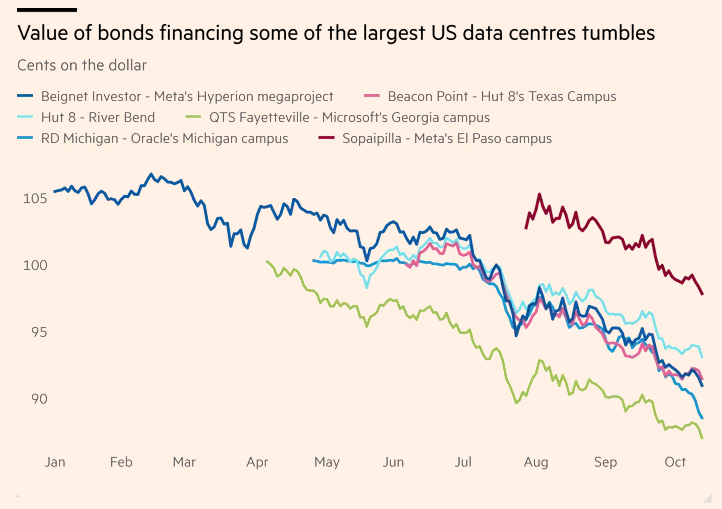
Chart of the week: Stress in AI-related credit is building up.
Source: Financial Times
According to a Financial Times article , investors are losing confidence that revenues from the AI boom will be sufficient to support the vast debt piles which are financing the data centers, pushing the bonds which are backing some of the largest US infrastructure projects into increasingly stressed territory. Prices of bonds issued to fund prominent data centers where Meta, Nvidia, Oracle and others will become tenants — such as “Hyperion” and “Project Excalibur” — have fallen well below par in recent weeks. The price of debt issued by Blue Owl and Meta-backed special purpose vehicle Beignet Investor to fund the Hyperion project has slipped from above par in early July to a little under 92 cents on the dollar. Separately, bonds backing two Hut 8-developed projects — one in Louisiana and another in Texas leased by Nvidia — have fallen to about 94 and 92 cents on the dollar respectively. Bonds for the Blackstone-owned QTS data center in Georgia dubbed “Project Excalibur” and leased to Microsoft have slipped below 88 cents on the dollar. Neocloud providers have been hit even harder. Bonds issued by CoreWeave have sunk below 80 cents on the dollar, pushing yields close to 15%. According to the same article, Gartner, the global research and advisory firm, said that AI data center owners would need to generate revenues of $8.5tn by the end of 2030 to cover their capital and financing costs and generate healthy returns on those investments. But it forecast that consumer and corporate spending on AI services that would flow to data center providers would reach “no more than $3.6tn”. “A continued AI infrastructure investment trajectory could leave more than $4tn in asset value exposed to write-down risk through 2032,” they concluded.
The content of this document has been produced from publicly available information as well as from internal research and rigorous efforts have been made to verify the accuracy and reasonableness of the hypotheses used. Although unlikely, omissions or errors might however happen.
The data included in this document are based on past performances and do not constitute an indicator or a guarantee of future performances. Performances are not constant over time and can be positive or negative.
This document is intended for informational purposes only and should not be construed as an offer or solicitation for the purchase or sale of any financial instrument and it should not be considered as investment advice. The market valuations, views, and calculations contained herein are estimates only and are subject to change without notice. Any investment decision needs to be discussed with your advisor and cannot be based only on this document.
This document is strictly confidential and should not be distributed further without the explicit consent of Kendra Securities House SA.