Thoughts of the week.
It seems that we will be talking about bonds for a while. Most of the media and analysis are focusing on the war in Iran and the spike in oil prices which caused inflation to rise and the central banks to react, to offer the view that bond yields will drop sharply when a deal is announced. This partly true, as bonds do not react well to inflation moving higher and indeed we should see a short-term rally in bonds, when eventually there is a peace agreement. But bonds also lose value (yields moving higher) if economic growth is too strong and/or governments run large fiscal deficits with growing debt levels. In our case both conditions are met. People might be forgetting that the 10yr US Treasury yield was already rising since last year, from a 3.90% low to 4.35% even before Iran was attacked on the last day of February, and that was despite the fact that the consensus was for rate cuts by the FED in 2026. In fact, bonds staged a rally in February with the 10yr reaching again 3.90%, just before the war started, as the stock market was selling off due to fears of a sharp economic slowdown and AI disrupting and destroying whole industries (cyber, software etc.), quite the opposite of what turned out to be the case.
It also seems that AI has played a significant role in keeping the economies strong, despite higher interest rates. The hard data show that AI-related technology investment is growing around 30% YoY, while the rest of business fixed investment is up just 0.8% and residential investment is contracting by 3.8%, which by itself does not point to a significant AI contribution to GDP. But looking at company data, there are signs of pick-up in non-technology related investment and production, as “old economy” firms are seeing rising demand for their output, a direct result of the AI buildout. Some of the examples are intuitive. GE Vernova and Siemens Energy make gas turbines and other significant infrastructure to power the data centers and Caterpillar is providing power plant generators en masse.
But other examples of companies who are beneficiaries of AI growth are not so intuitive. TOTO, which makes … toilets, has also expertise in ceramics also used to manufacture electrostatic chucks, important in semiconductor production. The “toilet” company grew its ceramics business by 34% in 2025 and the business now is accounting for over 53% of the firm’s profits. CBRE, the global leader in commercial real estate services, has seen critical infrastructure activities (including data centers, telecoms, and power infrastructure) rise to 14% of its EBITDA in 2025 from just 3% in 2021, and this will rise even further this year. Veolia, the French water treatment and waste management company is expecting 1bn € of revenues from data centers and the Swiss chemicals/insulation materials company Sika is sending its products to more than 1’000 data center sites globally, according to its latest report.
If we turn to Europe, there is a real Industrial renaissance. Looking at the New Manufacturing Orders subindex of the PMI report, the latest figure for the Eurozone is at the highest level since May 2022. Germany has taken an unprecedented decision to increase its debt in order to fund infrastructure projects and companies in the complex of AI beneficiaries are firing on all cylinders. Credit growth in the Eurozone is ever increasing, despite the spike in interest rates, which traditionally curbs lending and hurts the economy. It is no surprise that Europe has held relatively well in an environment of 90$+ oil , a fact that few economists would have guessed one year ago. One can assume further acceleration of growth when oil prices eventually retreat to the 60-70$ range again. At this point we should remind our readers that we had been discussing about the prospect of the ECB raising rates this year, long before the war in Iran and as early as late last year, exactly due to expected stronger growth and high government spending.
So there are a “thousand” reasons why yields will not return anywhere close to where they were a few years ago: high inflation, strong growth (US), higher government spending (Germany) and high levels of debt globally. We have probably moved to a long cycle of much higher interest rates compared to the cheap-money years of the 2010-2020 period. This could eventually cause trouble as higher interest rates typically cause lower equity valuations. If we take a look at the an attractiveness metric called Equity Risk Premium (ERP) , or in other words the premium that investors demand from equities vs holding bonds, this is back at being negative (i.e. bond yields appear much more attractive than equity valuations) vs a longer term average of 2-3%. This is clearly not sustainable. Of course it has been hovering around the zero line since 2025 and equities continued to move higher almost exclusively due to the AI theme, as we explained above. Last time we had a negative ERP was in the 1999 Tech bubble, but even then it stayed negative for more than two years, before eventually the market sold-off. So we cannot base any investment decision on this fact alone, but we can assume lower equity returns ahead compared to the last three years, with today as the starting point.
On a more positive note, “higher for longer” yields could act as a natural dampener for equities. Unless you are a short term trader or casino player, you would agree that a gradual rise in equity prices is much more preferrable than a run-away rally that will be followed by a crash. Higher yields make sure that the market will stay rather contained after three strong years, with earnings revisions and solid corporate results providing the necessary fuel for it to move gradually higher and find new equilibrium valuations in this new interest rate world.
Weekly highlights.
The Eurozone September Composite PMI rose 1.1 points to a 41- month high of 53.1, exceeding consensus expectations of a decline to 51.7. Both sectors, services and manufacturing, showed decent rates of growth, but the rise in the Composite PMI was driven by the stronger-than-expected Services PMI, which rose by 1.4 points to a 10-month high of 53.0 (consensus: 51.4). Following declines between February to June, aggregate new orders have now expanded for three consecutive months, while new export orders have grown for a second month after more than four years of contraction.
The US September Composite PMI rose to 58.4 from 56.0, well above expectations and its highest level in 62 months, while services activity reached 58.7 and manufacturing output 56.7, both multi-year highs. Demand strengthened aross both sectors, employment growth accelerated to its fastest pace in over four years, and backlogs of work increased sharply, signalling robust activity and continued capacity constraints.
The Swiss National Bank (SNB) left rates unchanged at 0%, in line with expectations. The central bank stressed that inflation remains within the range consistent with price stability throughout the forecast period, suggesting policymakers still see little urgency to begin raising rates, despite gradually firming consumer price pressures. The inflation forecast was revised up to 0.7% for 2026 (+10bp), and to 0.8% for 2027. The sentence on FX interventions took out the “increased willingness” language and now reads: “The SNB is also willing to be active in the foreign exchange market as necessary to ensure appropriate monetary conditions.” Maybe the SNB is less worried now about the level of the franc than three months ago.
Markets’ reaction.
Global equities managed to stage a rebound, against the rising yield headwinds. Driven by US Technology (+2.5%) , Nasdaq managed to register a new record high despite the spike in bond yields and the continuing turmoil in the Middle East. Hope is what is driving the markets today, with participants betting on a positive outcome out of Iran and the AI theme remaining dominant. US small caps, however, lost ground with Russell 2000 dropping 1.2% for the week. Europe posted decent gains as the momentum trades were revived , despite volatility in financials and consumer discretionary. The Euro Stoxx 50 index rose 1.2% for the week. In Asia, the chip-heavy Kospi index rose 2.7% and Japan was solidly up (2.1%). On the contrary, Hang Seng and local Chinese markets dropped 1.5%, each.
The bond market was a bloodbath again. The strong PMI numbers pushed the 10yr US Treasury to 5.20%, the highest in more than twenty years while the 30yr mortgage rate rose close to 7.50%, making the purchase of a new house by those without equity wealth almost impossible. The 10yr Bund yield rose to 3.60%, levels last seen fifteen years ago.
Gold fell 2% for the week , trading as low as 4’250$ before making a modest attempt to rebound closer to 4’300$ again. Higher yields and higher dollar are not the yellow metal’s best friends.
The dollar continued to strengthen. The EURUSD fell below 1.1400 and touched a low of 1.1350 before recovering. The market now believes that three more hikes by the FED are going to take place in the next few months.
Chart of the week: Low quality, leveraged companies could soon have a problem.
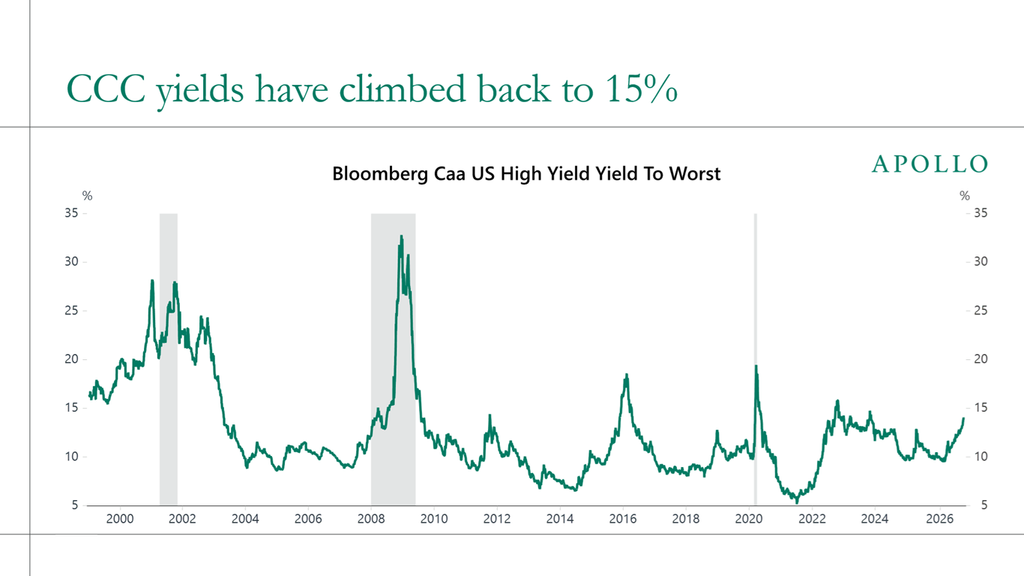
Source: Apollo Management
Higher for longer which we discussed above could be a time bomb for very low-quality credit. Every month rates stay elevated, more CCC borrowers from the 2021–22 vintages have to re-refinance at very high rates with less cash to service their debt, and with yields around 15% (in USD). The Fed’s monetary policy is working with a lag and is working unevenly. While the broader credit market stays calm, the bill from the cheap-money era is landing on the weakest balance sheets first. The pain is sharpest in heavily levered, Private Equity-backed technology, healthcare and consumer discretionary names, where floating-rate debt, thin margins and AI disruption risk leave little room for error. Strong balance sheets have locked in cheap fixed-rate debt and have barely felt the Fed’s tightening, while the most leveraged borrowers feel it in full, as floating-rate costs and maturities reset. We chose to stay on high quality bonds and monitor very carefully the high yield bond funds to see how they are navigating this new environment.
The content of this document has been produced from publicly available information as well as from internal research and rigorous efforts have been made to verify the accuracy and reasonableness of the hypotheses used. Although unlikely, omissions or errors might however happen.
The data included in this document are based on past performances and do not constitute an indicator or a guarantee of future performances. Performances are not constant over time and can be positive or negative.
This document is intended for informational purposes only and should not be construed as an offer or solicitation for the purchase or sale of any financial instrument and it should not be considered as investment advice. The market valuations, views, and calculations contained herein are estimates only and are subject to change without notice. Any investment decision needs to be discussed with your advisor and cannot be based only on this document.
This document is strictly confidential and should not be distributed further without the explicit consent of Kendra Securities House SA.