Thoughts of the week.
In business and every day life when we refer to the “last mile”, we usually refer to the hardest part of a “journey”. Marathon runners know that the last mile could be physically and mentally the hardest. However, the term was originally used in the telecommunications industry to describe the difficulty of connecting end users’ homes and businesses to the main network, as they had to install cables to individual homes, one by one. In freight networks, parcels can be delivered to a central hub efficiently via ship, train or other means, but they must then be loaded into smaller vehicles for delivery to individual customers, which is the costliest and more complex operation of the whole process.
Asset Managers face a similar situation today, as we are entering the final stretch of the year. As the 3rd quarter came to a close, the trend has been clear in favor of the AI-related stocks on both sides of the Atlantic, whereas the Technology sector in Europe (+44%) has done remarkably better than the US equivalent (+36%). Of course the European Tech sector is dominated by ASML , whose shares have risen by 80% this year so far, followed by Infineon with a 70% gain. European Industrials with related business in the data center buildout have also seen their shares rally, albeit in a volatile manner especially during the summer.
But looking at others sectors, we rarely see such divergence between the US and Europe. US Healthcare has provided returns (+8.8%) which track relatively closely the S&P500, while in Europe the sector has been a drag (-6.5%) to portfolios. Defensive staples have produced decent gains in the US (+3.8%), while they are marginally negative in Europe. On the contrary, Utilities (+16.5%) have outperformed the indices in Europe, while they have fallen by more than 7% in the US. And European Financials (+15.5%) have massively outperformed their US peers (-2.5%). The investment world seems to be buying global Tech together with European Industrials and Banks and everything else is scorned.
As we enter the final quarter of the year, we could be in for surprises. On the macro level, the world’s major central banks will continue hiking interest rates and leveraged companies are going to face trouble refinancing their debt. Politics will take center stage in the US , with the mid-term elections potentially causing Trump losing total control of the Congress. At the company level, third quarter results will soon be coming through and given the current market levels in the US, investors will not be looking at simply matching the already increased expectations but will be asking for even more “beat-and-raise” announcements by the AI-related companies, with no room for the slightest miss. Finally, the much awaited Anthropic IPO is in the cards (for mid November) which would be a major catalyst for Technology, in both directions.
The question that begs answering is how to position until year end. Momentum investors will have not hesitate to answer: stay with the trend which calls for buying companies in the AI theme at any price and valuation and sell everything else. This has worked nicely for nine months and they see no reason why this should change. To their credit, high bond yields do not really matter for these companies as their sales and earnings growth can outpace the drag from much higher yields. To finance their leveraged positions, hedge funds have been shorting the laggards and primarily the consumer-related stocks, many of which still try to stabilize their sales and earning trajectory. The short-sellers investment point is that the consumer is suffering from high inflation globally and sales are not expected to return to sustainable growth in the foreseeable future. The end result is that one has to go back more than a decade or perhaps two to find similar low valuations for many stocks in this universe.
In our portfolios, we have remained with increased cash which has helped during the volatile month of September. Our High Conviction portfolio has remained almost unchanged for the month, while the index is down about 3%. Our High Income strategy is down less than 3% for September while similar funds are down more than 5% in the same period. But this excess cash is soon going to be deployed. It is not clear yet to us whether we should increase the momentum stocks or build positions for 2027 in stocks which are now thrown in the garbage by investors and traders. We are walking the last mile with extreme caution, not only on how equities will finally fare but primarily how equity sector allocation will evolve.
Weekly highlights.
Eurozone’s September inflation rose by 0.6pp to 3.8% y/y, above consensus (3.7%). The main driver behind the jump in the headline number was a rise in energy prices (+18.8% y/y), although higher food inflation also contributed. Core inflation (ex food and energy) also ticked up 0.1pp to 2.5% y/y, solely driven by an increase in services inflation to 3.2% y/y (related to transportation, accommodation and holidays). Looking ahead, the fuel tax cut in Germany and other government subsidies should help to keep Eurozone headline inflation stabilize.
The US PCE index , which is the Fed’s metric of inflation, was on the surface better than expected. The headline number rose by 3.4% y/y, against consensus of 3.7%, while core prices rose 3.0%, against consensus of 3.3%. However we should note that the lower than expected inflation is primarily due to the revision of how the index is calculated. The BEA’s at its annual update, which revised Q1 2021–Q1 2026 calculations, made changes in portfolio management, legal services and software. Given these changes, July’s number was also revised lower to 3.4% from 3.7%. On another note, real consumer spending rose 0.6%, which is the strongest since March 2025 and which could offer some relief to lagging consumer stocks.
The September US labor market report was weaker than expected. The monthly non farm payrolls were published at just +29k vs expectations for +90k. Prior months were also revised down -60k. The unemployment rate moved up 0.1 pp to 4.2% vs expectations of 4.1%.
The G7 agreed to release up to 100 million barrels of diesel and crude over the next four months in an effort to reduce fuel prices. French President Emmanuel Macron, who currently chairs the G7, said the coordinated action is intended to “trigger a drop in fuel prices” and President Trump welcomed the decision, posting on Truth Social: “Europe has just agreed to release a massive amount of their heavily stocked Diesel Oil. The process will begin immediately “.
Markets’ reaction.
Global equities lost ground , as yields rose to new highs. During a volatile week, the S&P500 dropped slightly by 0.2%, supported by Technology and the resurgence of the memory chip trade. Actually, Nasdaq managed to post a modest 0.5% gain. Europe was under pressure with the broad indices down about 1%, but France underperformed (-2%) and the CAC40 is now down 3% for the year. The Euro Stoxx 50 has lost more than 8% from its recent high. Asia was broadly down, with Japan bucking the trend with a 2.9% gain, while even the chip-heavy Kospi fell 1% for the week.
The bond market was volatile. The US 10yr yield crossed the 5.30% level before retreating to around 5.20%, while the German 10yr yield crossed the 3.60% mark but fell closer to 3.50% at the end of the week. The French 10yr approached 5%, with the spread over Germany exploding higher than 140bp.
Gold fell 3% for the week , trading closer to the 4’100$ level before rebounding to close the week at 4’150$. Stronger dollar and higher yields are not the yellow metal’s best friends.
The dollar continued to strengthen. The EURUSD below 1.1300 for the first time in months, while the CHF also strengthened as the turmoil in French assets brought buyers to the safe heaven. The EURCHF fell closer to 0.9300.
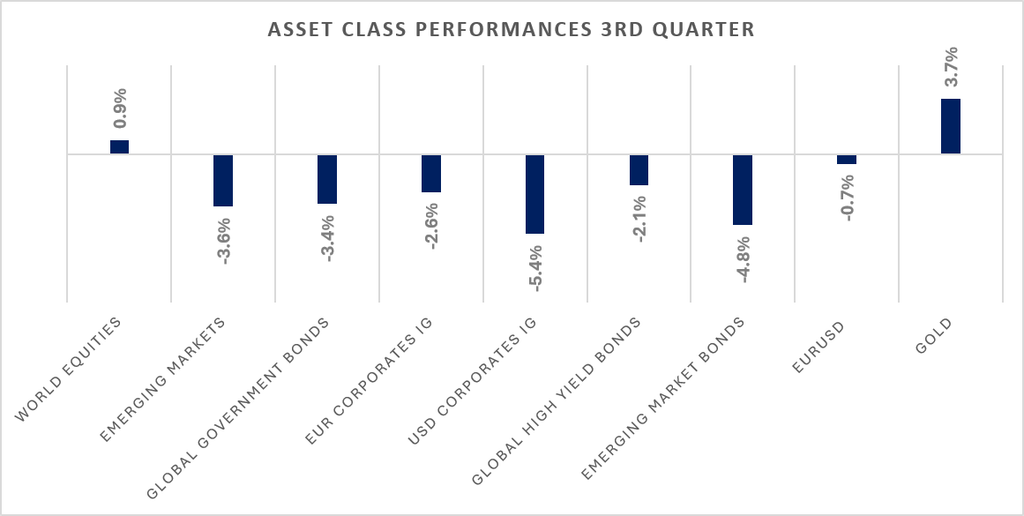
Chart of the week: A quarter to forget.
Source: KSH / FactSet
There was no place to hide in the third quarter as the bond market’s sell off was more sizable than the meagre 0.9% return of Global Equities (in $) in the same period. We had discussed several times the possibility of higher yields before the summer, which eventually happened and to an extent that it would normally cause significant trouble to equities. This also proved partly true as Europe fell by more than 8% from its recent highs and some stocks/sectors moved to new 52-week lows, but the AI theme is so strong in the US that local equities (at the index level) did not move much despite the 10yr yield reaching 5.30%. In the US, Energy (+15.6%), Healthcare (+6.5%) and Technology (+2.7%) were the only positive sectors for last quarter, while in Europe it was Energy (+21.2%), Financials (+3.4%) and Materials (+2.8%). The fourth quarter could bring a better picture, especially if bond yields find an equilibrium at slightly lower levels than the recent highs and based on the positive seasonal pattern.
The content of this document has been produced from publicly available information as well as from internal research and rigorous efforts have been made to verify the accuracy and reasonableness of the hypotheses used. Although unlikely, omissions or errors might however happen.
The data included in this document are based on past performances and do not constitute an indicator or a guarantee of future performances. Performances are not constant over time and can be positive or negative.
This document is intended for informational purposes only and should not be construed as an offer or solicitation for the purchase or sale of any financial instrument and it should not be considered as investment advice. The market valuations, views, and calculations contained herein are estimates only and are subject to change without notice. Any investment decision needs to be discussed with your advisor and cannot be based only on this document.
This document is strictly confidential and should not be distributed further without the explicit consent of Kendra Securities House SA.