Thoughts of the week.
In electromagnetism, a signal is the intended wave or electrical current that carries information, while noise consists of random and unwanted fluctuations. In our every day life, a signal is the essential and useful information that allows us to understand a situation, while noise is the sum of all distractions around us which hinder the process of thought and decision making. This concept of noise vs signal most certainly applies to financial markets as well. Noise refers to misleading information which could come from social media posts, financial media headlines and volatile short-term price action, all of which obscure the signals, or in other words what really exists under the surface.
We have been experiencing a strong rotation out of AI beneficiaries and into laggard sectors for more than three weeks now, which has left investors wondering what is going on. For our readers with good memory, they know that we had warned about this. The market commentators and self-proclaimed analysts are now divided into two camps: the ones who believe that this is just a short term blip in the theme and the others who are now forecasting the Armageddon. For us, all this is simply noise. To truly understand not what comes next in a matter of days or weeks but how the AI theme will look like in 6-12 months from now we need to withdraw ourselves from the day-to-day price action and make a short trip on memory lane.
Stock and sector performance in late 2024 and 2025 was one hundred per cent linked to the AI-theme. It was the time that the majority of investors discovered the companies which would see their revenues positively impacted by the construction of thousands of data centers which are needed to host the vast demand for AI. The market (and so did we) jumped to the most obvious AI beneficiaries, primarily the Industrials who build the necessary electrical and power infrastructure for a data center to operate (Prysmian, Schneider, ABB, Siemens Energy, etc.). Shares of such stocks spiked higher, with some of them producing returns of 100%+ in less than two years, while valuations reached levels that could have never been imagined by their CEOs.
The current year started with the same enthusiasm for the same stocks and valuations moved even higher, sparking analysts’ orgasmic upgrades of strong revenue growth extrapolated to … infinity. But around the middle of the year, the market realized that there is a “commodity” that is in scarce supply and which is critical to the massive storage needs of data centers, namely the memory chips. Traders and investors (and so did we) jumped on the memory chip companies (as well as IT hardware companies) who were now able to charge their clients a price of 5-10 times more, for exactly the same product as a few months before. Anyone can do the calculation of how this price explosion affected their revenues, with volumes remaining stable or a little changed as there is a specific number of chips or servers these companies can produce annually with their current capacity. The end result is that memory chip and IT hardware stocks moved up 200%+ this year, while the 2025 winners did not shine anymore and started correcting. Before the summer’s correction, we decided that the explosion of memory-related ETFs (always a bad sign when retail goes all-in), the extremely high leverage and investor mania were noise and completely sold our positions. Our main point (i.e. the signal) was that explosive sales growth based on price alone is never sustainable and the very cyclical nature of their product made us cautious. The exit from memory chips has proved wise, for now.
And we now find ourselves ahead of 2027, asking what next year will look like, as AI will undoubtedly remain the main focus for markets (for good or bad). The fate of the AI beneficiaries will be determined by the trajectory of the capex cycle. For any capex cycle to stall or decline, there are two catalysts: lower demand for the end-product or lower supply for it. Since we still hold the view that AI demand will only continue to increase, this capex cycle will be shaped by the industry’s ability to deliver capacity.
We have talked above for the limitations of producing enough semiconductors for the world’s needs. But this is only part of the picture. Energy supply, access to skilled staff and the permitting required to build new data centers are increasingly important bottlenecks. Add to all this, the explosion of the total cost to build a new data center not only because of the components’ price explosion but also the much higher interest rates to finance these projects, compared to a year ago. Bottomline, more and more data center constructions are being delayed or cancelled all together and we can safely assume that the expected growth rates for AI beneficiaries must come down for 2027. This is not necessarily bad, it is what we call normalization, and it does not mean that AI is a bubble, on the contrary its use will continue to expand. But many traders/investors might have not been prepared for that normalization of expectations and hence valuations.
We will probably hear in the upcoming Tech results that capital spending on AI infrastructure in 2027 will be revised even higher. The market will cheer and the media will announce the end of the AI-beneficiaries correction. Pause here for a minute, block the noise out and find the signal in the news : the dollar cost of building the same data center has spiked higher, so yes they will have to raise their capital spending plans in 2027 but for the same compute capacity… I am not sure this is exactly good news. On the other hand, we might hear that they are planning to moderate their spending plans, just because of all the reasons I outlined above. This could also spell bad news for the AI beneficiaries. A first sign for this could have been offered by Meta last week, which announced lower than expected Q3 capex and did not raise its capex guidance. A very interesting week lies ahead.
Taking the view that we are moving into a lower (and more sustainable) growth for these stocks we took action again and completely sold our position in Dell Technologies, as it was deemed to be the most exposed to the AI theme (65% of revenue), among the stocks that we hold. Our analysis also showed that the European Industrials (Prysmian, ABB, Siemens Energy etc.) have already corrected to valuations that discount a sizeable slowdown in their revenue growth and their data center exposure is estimated at less than 15%. Hence we are keeping these positions for now, but are not willing to increase exposure yet.
The week’s highlights.
The Eurozone’s October Composite PMI fell to 51.9 in October from 53.1 in September. That figure was below expectations (52.7) and while it remained above the 50 threshold, it signals a moderation in private-sector activity at the start of Q4. The slowdown was broad-based across both major sectors. The Services PMI remained in expansion territory (51.7) but lost momentum, while the Manufacturing PMI also continued to signal expansion (52.4), albeit at a slower pace. At the country level, France slipped back into contraction (48.4 from 51.1 last month), while Germany and the rest of the euro area continued to expand. New orders increased for a fourth consecutive month but grew only marginally and at the slowest pace of the current expansion phase.
Despite all the recent trouble, France kept its AA rating , as confirmed by Moody’s on Friday. The rating agency said that it was maintaining its rating of Aa3 with a negative outlook. Despite slower growth and a higher deficit since its last ratings decision, Moody’s opted not to downgrade because it “assumed that a deficit-reducing budget for 2027 will be adopted, while financing costs and social tensions will abate somewhat in the next few months“.
The major US Tech companies report earnings this week: Microsoft and Alphabet report after the US close on Wednesday, Amazon follows on Thursday while Apple closes the series next Monday. It is important to note that these five companies make up about 30% of the Nasdaq 100 index, on which most of the Nasdaq ETFs are based.
Markets’ reaction.
Global equities had a volatile and finally negative week. In the US, the S&P500 fell by 0.5%, brought down by Nasdaq (-0.7%). On the contrary the S&P500 Equal Weight index rose almost 2%, as most of the sectors, apart from Technology, posted weekly gains. Europe was broadly down as the AI-theme took a hit, with Industrials down 5% and Technology -2.5%. However Healthcare and Staples had solid gains, confirming our view that diversification at this junction is absolutely necessary to protect equity portfolios. Energy was also strong, as oil prices moved to new multi-week highs.
Bonds rebounded again, with global government bonds the only positive asset class last week. The US 10yr yield fell below 5% and the German equivalent touched a low of 3.30%, almost 30bp down from its recent high. However, the French-German 10yr spread spiked to a new multi-year high of almost 170bp. As a reminder this spread reached 180bp at the depth of the Eurozone crisis in 2011.
The dollar traded in a tight range, against the EUR. The cross rate spent most of the week around 1.1200, as the market was focusing on the situation in the Eurozone, while the EURCHF fell to 0.9200 in a typical flight-to-safety move by traders.
Gold sold of and touched the 4’000$ handle. The move is very surprising as all forces that impact Gold prices were in its favor last week : lower yields, equity turmoil, higher oil prices. It remains to be seen if this level provides again support as it did several times a few months ago.
Chart of the week: The AI build-out is no longer financed by cash.
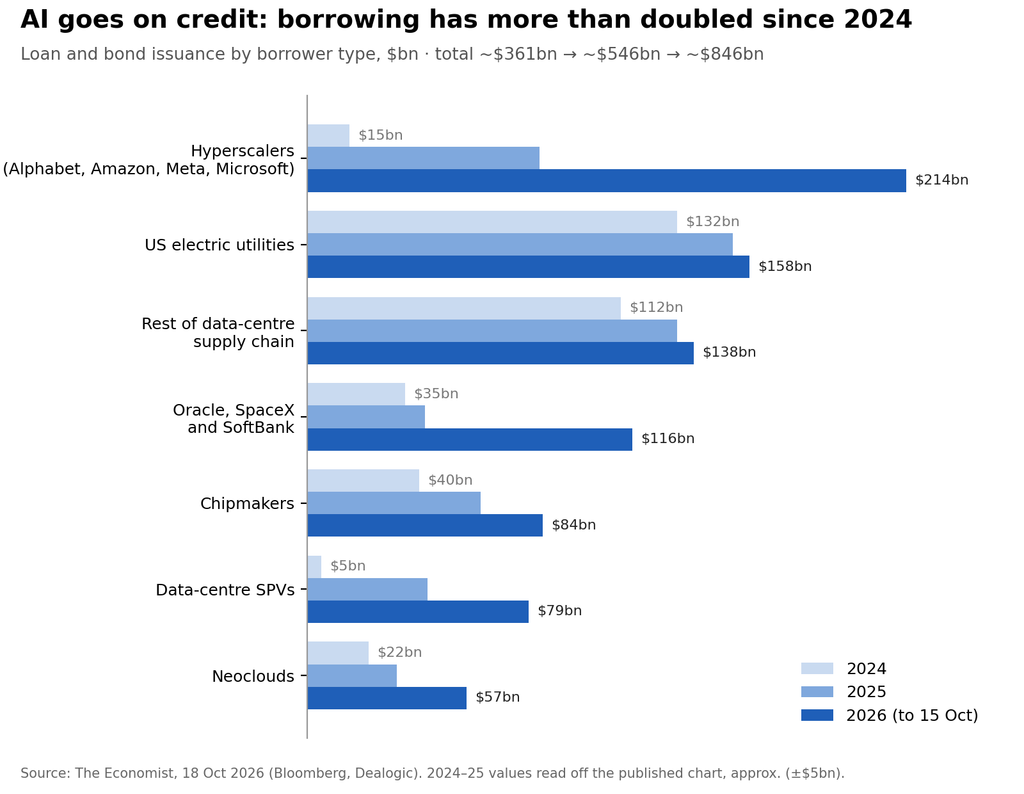
We discussed above how higher interest rates are making the data center buildout more expensive to finance. This would not really matter if companies were using their vast free cash flows, but these have already turned negative and hence even the mega techs have resorted to borrowing. The amounts are staggering: AI-related companies have raised close to $850bn in loans and bonds so far this year, according to data compiled by the Economist. That is more than double the 2024 level and roughly four times 2023. The Hyper-scalers alone have borrowed $214bn, compared to $15bn two years ago. Data-center SPVs, a structure that barely existed in 2024, have issued close to $80bn. The headline numbers also understate the real leverage. The five largest cloud providers have a further $2.7tn of leases not yet started and purchase commitments that are not on their balance sheets. Guarantees between companies, such as Nvidia’s backstops on up to $300bn of its customers’ debt, make it hard to see where losses would land. Increased spending now starts to hit to the balance sheets: and credit markets are starting to take notice. Oracle’s spread has shot up to more than 300bp, while Meta’s spiked to 100bp last week, which is considered very large for a (still) AA-rated company.
Sources : Chart: The Economist, Bloomberg, Dealogic
The content of this document has been produced from publicly available information as well as from internal research and rigorous efforts have been made to verify the accuracy and reasonableness of the hypotheses used. Although unlikely, omissions or errors might however happen.
The data included in this document are based on past performances and do not constitute an indicator or a guarantee of future performances. Performances are not constant over time and can be positive or negative.
This document is intended for informational purposes only and should not be construed as an offer or solicitation for the purchase or sale of any financial instrument and it should not be considered as investment advice. The market valuations, views, and calculations contained herein are estimates only and are subject to change without notice. Any investment decision needs to be discussed with your advisor and cannot be based only on this document.
This document is strictly confidential and should not be distributed further without the explicit consent of Kendra Securities House SA.