Thoughts of the week.
Tomorrow Tuesday, the US voters will decide who controls the Congress, and therefore how much power Trump will have in the final two years of his term. Before we get into the potential investment implications, it is useful to know what is at stake. All 435 seats in the House of Representatives are up for re-election, with 218 needed for a majority. The House is currently split 220-213 in favor of Republicans, with two vacancies. In the Senate, 35 of 100 seats are contested. Republicans are defending the 53-seat majority they won in 2024, and Democrats need to flip four Republican seats without losing any of their own, because Vice President Vance will still hold the tie-breaking vote; a 50-50 Senate stays Republican.
In the last five elections the governing party has always lost one of the Chambers or both, as was the case with President Bush in 2006. The below table summarizes the net changes and who took control after:
| Year | President | House (net change) | Senate (net change) | Control after |
|---|---|---|---|---|
| 2006 | Bush (R) | D +31 | D +6 | Both chambers R → D |
| 2010 | Obama (D) | R +63 | R +6 | House D → R |
| 2014 | Obama (D) | R +13 | R +9 | Senate D → R |
| 2018 | Trump (R) | D +41 | R +2 | House R → D |
| 2022 | Biden (D) | R +9 | D +1 | House D → R |
According to prediction markets the probability of Democrats winning the House has recently risen to above 90%, while for the Senate the probability currently sits at a “flip of a coin”. The “almost certainty” of the House flipping to Democrats lies on the fact that congressional district lines have been recently redrawn to the point where there are less than 20 truly competitive races. The vast majority of the 435 seats in the House are now comfortably either Democrat or Republican, which makes the prediction much easier. The Senate, meanwhile, is tougher to predict. But rising energy prices and higher inflation due to the Iran war has pushed Trump’s approval ratings sharply lower, and hence Democrats could win both chambers.
Historically, midterm elections cause some noise but do not real damage the stock market. We should not forget that we are entering the traditionally best two months of the year, in terms of historical equity performance. But, if we take Trump’s first term as a guide, then things start looking a bit scary. Back in 2018, when the House also turned Democrat, the market reacted in two stages. The day right after the election the S&P500 rallied 2%, but that gain didn’t last. A precipitous fall followed and from election day to year-end the index finally fell 9.0% and nearly 20% from the September peak. A common factor with that period is that the Fed was also raising interest rates, but since the starting point was 0.25% in 2016, rates had been raised to “only” 2.25% by December 2018. They now sit at 4% and potentially moving higher in December’s meeting.
Fast forward to today and things look even scarier. The mega Tech results were met with disappointment by investors and failed to provide the necessary catalyst for the market to escape the range-trading pattern, established since early August. The S&P500 has been trading between 7’500 and 7’800 since then, failing to break out to new highs. The market has been increasingly focusing on the deterioration of free cash flows and the explosion of debt obligations of the big spenders, happening at a time of very high interest rates. These companies have now transformed to capital-heavy companies with lower ROIC (return on invested capital), and with valuations that appear attractive on paper, but more compliant with their new, weaker balance sheets. The comparison of the Hyperscalers (once-asset-light/huge free cash flow companies) to the Telecom companies of the late 1990s can easily be made, although this might turn out to be wrong. The issue that arises, and which we have highlighted several times, is whether these big spenders will eventually curtail their spending to protect their balance sheets or not. In the first case, the data center beneficiaries will experience their revenue estimates revised lower for 2027 and 2028.
And now there is also a political angle in play. A major catalyst in the elections will be the angry voters from the states that have been the primary hosts of new data centers, which has caused spikes in electricity bills among other environmental issues (water, land usage etc.) A possible Democrat sweep could convince the market that the AI-buildout plans would be reconsidered and a government-led slowdown could be enacted, especially at today’s high inflation environment.
However, technically, US equities appear oversold, and a technical bounce might be the most likely scenario in the days to come. According to the latest data, hedge funds have massively reduced their exposure, which means we might have what we call seller exhaustion, or in other words not enough selling volume to drive equities much lower, for now. What matters most in not what happens in the next three four weeks, but getting prepared for 2027. In this volatile environment, remaining diversified and vigilant is the wise option. The defensive part of our portfolios as well as the positions in previous laggards, which have finally started to work, have contained the damage from the recent AI sell-off and we see no reason to change that soon. Copying-pasting 2025 and 2026 for the new year might not be the best investment option.
The week’s highlights.
The Fed kept rates on hold, at 4%, as widely expected. There were two board members who voted for an increase. Chairman Warsh had interesting remarks at the press conference, which sounded more dovish than expected. He mentioned that he disagrees with the market consensus that higher rates cannot affect AI related companies, saying that cracks are already appearing in credit markets. He also said that inflation expectations have moved lower. He finally announced less rate-setting meetings in 2027 and 2028. The market still has a 90% priced-in probability for a December hike, the last meeting of this year.
The ECB also left interest rates unchanged, as expected. The statement stressed both upside risks to inflation and downside risks to growth, while the explicit mention of tighter financial conditions in the context of higher bond yields also contributed to an impression of a dovish tilt. Yet Mrs. Lagarde’s press conference was not outright dovish. She said that the Governing Council had discussed whether a rate hike at this meeting would be appropriate, although it eventually decided unanimously against one. Mrs. Lagarde also said that a “measured pace” remained appropriate and that the “direction is clear“, indicating that rate hikes are set to continue. She also announced that she is stepping down as President in February, eight months before the official end her 8-year term, with speculation rising about a potential involvement in the French elections and politics.
German construction orders surged 23% month-on-month in August, the largest monthly increase since the series began in 1991. There were healthy increases across the board, with building construction up 12.4% mom and civil engineering up 31.6%. But the standout was “civil engineering excluding road construction”, where orders jumped 40.4% mom. Construction and related companies (such as Heidelberg Materials, Sika etc.) should do well in this environment where the the large government stimulus is finally showing up in the numbers.
Markets’ reaction.
Global equities had a mixed week. US equities were dragged down by the late-week sell-off in Technology, with Nasdaq losing 2% and the S&P500 falling 0.5%. On the contrary, the broad European indices rose by almost 2%, helped by the rally in Healthcare (+4.5%), Industrials (+3.5%) and Discretionary (+2%). However, all sectors finished the week in the green. Interestingly also in the US nine out eleven sectors posted solid returns with only Tech (-2%) and Communications (-5.3%) falling. The Nasdaq-100 is now 10% lower from its recent record high, which was set only three weeks ago, a typical correction level which could be bought by the market.
Bonds continued to rebound, as US Tech was selling off. The 10yr US Treasury fell to 4.93%, down almost 50bp from its recent high. EUR yields also moved lower, with the 10yr Bund below 3.35%.
The dollar traded in a volatile manner. The EURUSD fell close to 1.1100 before rebounding to close the week above 1.1200 again. The EURCHF fell below 0.9200 but then rose closer to 0.9300 again.
Gold sold off and broke below the 4’000$ support level. It closed the week below 3’900$ dragged down by further unwinding of speculative positions and liquidations by long-only investors. We decided to exit completely our positions in Gold, as history has shown that after a large spike , part of which was driven by speculation and ETF-related retail investor activity, the metal enters a period of correction and consolidation which could last for several quarters.
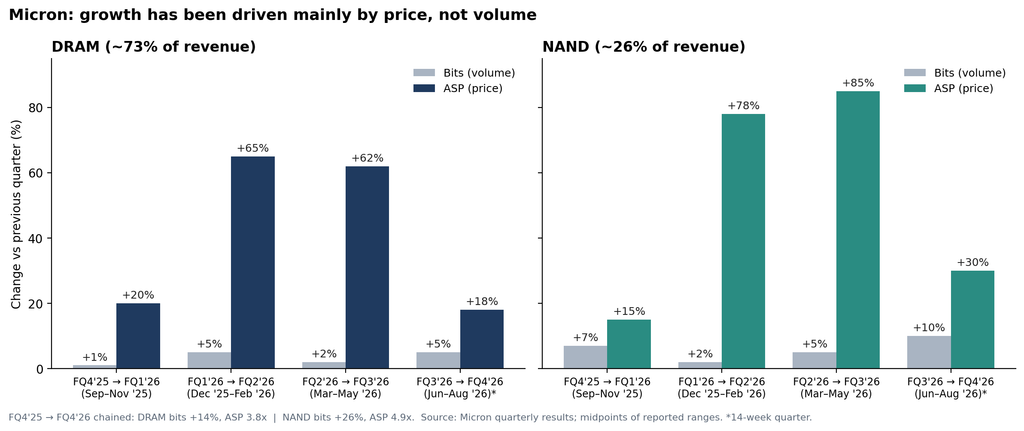
Chart of the week: Price alone has driven the explosion of revenues in memory chip companies.
Sources : KSH / Micron Technology
Reading the headlines about the explosive revenue growth of memory chip companies is perhaps not enough. To this end, I have charted above the breakdown between price and volume for Micron Technology, as a proxy for memory chip companies. There are two types of memory , DRAM shown on the left and NAND shown on the right. It is very apparent that due to supply constraints the price of their products have exploded higher (blue and green bars), but the actual volume growth (grey bars) is very small (all figures show on a quarter-to-quarter basis). This is normal, of course, as they are operating at full capacity and there is a given number of chips they can produce, without huge further capital spending. But this also means that the 2027 and 2028 high expectations are based on the fact that prices will remain at these extremely high levels, which also affect the cost for making PCs and almost any other electronic device. For those who believe that prices will remain at current levels or move even much higher, memory chips are indeed a bargain, trading at just 4-5 times their earnings. But we have also tried to simulate scenarios of price drops, which are very common in memory chips: a 30% drop in price will impact profitability by about 40% and an 80% drop (as it happened in 2018-2020, ironically the final years of Trump’s first term…) will wipe out all profit. And if these price drops seem excessive, note that a 30% drop will bring them to where they were just at the beginning of 2026, which is already more than double their early 2025 level. Truth to be told, given today’s very tight supplies, analysts expect prices to continue to grow well into 2027 and 2028. We are just showing how sensitive valuations of memory chip companies are to prices.
The content of this document has been produced from publicly available information as well as from internal research and rigorous efforts have been made to verify the accuracy and reasonableness of the hypotheses used. Although unlikely, omissions or errors might however happen.
The data included in this document are based on past performances and do not constitute an indicator or a guarantee of future performances. Performances are not constant over time and can be positive or negative.
This document is intended for informational purposes only and should not be construed as an offer or solicitation for the purchase or sale of any financial instrument and it should not be considered as investment advice. The market valuations, views, and calculations contained herein are estimates only and are subject to change without notice. Any investment decision needs to be discussed with your advisor and cannot be based only on this document.
This document is strictly confidential and should not be distributed further without the explicit consent of Kendra Securities House SA.