Thoughts of the week.
Going to work after summer vacations has always carried the “back to school” sentiment. Then again, in this part of the world, schools indeed start today ! I remember as a student that the first few days were always an opportunity to share with friends the summer experiences, what happened and what did not, what made us happy, angry or sad during vacations. Of course, those were the days without social media, smartphones or internet and you had to wait a few months to learn the news of each other. Today, I am going to do the same. In this week’s newsletter I will try to update you with the main developments of the previous three weeks , what we got right, what we got wrong and how the next few weeks could look like.
In equities, our forecast for a hot summer has been confirmed. European and US main indices have been reaching new highs and memory stocks underwent a major correction, which we had also said that it is very likely. The Korean Kospi index lost almost 50% from its June high , due to the fact that two memory stocks (Hynix and Samsung) comprise more than 40% of the index, and whose price collapsed despite strong results. The index has recovered almost 30% from its recent intraday low, and is now about about 25% below its record high. We had highlighted very high leverage and overcrowded positioning in mid-July as a potential risk, which eventually played a significant role in the sell-off, as positive fundamentals have not changed.
The Q2 earnings period was impressive, both in Europe and the US. The blended, year-over-year, earnings growth rate for the S&P 500 is so far 50.4%, the highest since Q2 of 2021, boosted by extraordinary profits in semiconductor and other Tech names, but also Energy due to the spike in oil prices. The overall revenue growth rate is currently running at 15%. In Europe, the Stoxx 600 index is currently delivering about 23% of earnings growth vs last year, a stunning number for the region. Truth to be told, this number is skewed by extraordinary gains in Energy companies, but profits in Banks, Industrials, Technology and Basic Materials have been red hot too, this year.
In bonds, our fear for higher yields has also been confirmed. The US 10yr is now at 4.70% while the 30yr has broken above 5% and reached a high of 5.30%. We should note that a significant catalyst, besides inflation, for yields to remain elevated if not rise further, is the US budget deficit which has widened further in July according to the data released last week. In the first 10 months of the government’s fiscal year , it rose to nearly $1.8 trillion and surpassed the same period in 2025. The July shortfall totaled $432.3 billion, up 48% from the same period a year ago and is the largest monthly deficit since March 2021. We remain cautious on long-end bonds.
Gold has rebounded , despite our fears for further weakness. The yellow metal gave a big fight around 4’000$, which we had highlighted in previous newsletters and finally jumped by about 10%, as retail investors flocked back. Our cautiousness was based on potentially higher yields and weak seasonal patterns until October/November, when the physical buying starts for the Asian wedding period. It is too early to declare victory, perhaps.
The situation in Iran is still fluid, but there is hope for an eventual solution. On the positive side, Trump is definitely not going to further escalate as mid-term elections are now just three months away. It is also important to note that the largest importer of oil, China, has proven critical in stabilizing prices, curtailing imports and using their vast strategic reserves as well as other transportation routes. The Middle Eastern producers have also been successful in channeling their oil through pipelines and other means, to cover up for the Hurmuz strait supply loss. The oil market has taken notice of all these positives and prices are still about 30% lower than the April peak, when fear dominated. We assume that oil prices will remain contained for the next few months.
All in all, the background appears to be positive for financial markets, at least until we start approaching the midterm elections in the US (early November). Potential negative factors remain the FED’s moves , the yields and a severe escalation in the Middle East. No major changes have been made to our portfolios in this last period, with some profit taking in Energy at the recent highs and an equivalent increase in Financials.
Weekly highlights.
US inflation cooled further in July. The headline CPI fell to 3.4% in July, a touch less than expected (3.5%) and much lower than the 4.25% peak in May. The core CPI, after rising from 2.5% in February to 2.9% in May it fell back to 2.5% in July. Gasoline prices had again a negative impact, but data so far from August suggest that gasoline prices will be an upward influence on next month’s CPI. Consumer goods prices kept rising at a fast pace and especially computers and electronics (primarily due to the memory chips price increases). At the Producers level, the PPI index also dropped , to 4.7% vs 4.9% expected and 5.5% in May. Overall, the data are comforting that the direction of travel is southbound, but the absolute figures remain high with respect to the FED’s targets.
Nvidia teamed up with Wall Street firms on a $500 billion plan, to provide capital to small AI companies so that they can buy the company’s chips. The issue is that many small AI labs, cloud companies and enterprises that have ravenous demand for Nvidia chips face high interest rates if they want to finance purchases of them. With the announced plan, companies in Private Equity and Credit markets such as Apollo, Blackstone and KKR together with Blackrock and Goldman Sachs will essentially use Nvidia chips as collateral (!!) to provide the financing, and these loans will then be sold to investors. Traditionally the value of semiconductor chips has had a fast decay as technological evolution is rapid and prices eventually drop, which begs the question how wise is for investors to place money in these securitized bonds, and what happens if these blow up.
Markets’ reaction.
Global equities had a lackluster week. After the rally of late July/early August , the S&P500 consolidated with a 0.4% gain, while Europe finished marginally lower. Overall the momentum trades (AI-related, European Industrials, electrification) performed better, although intraday volatility was again high. In Europe, there was major divergence in sector performance, as investors/traders sold aggressively Healthcare, Staples and Discretionary, which had done very well during July’s turmoil, to go back into the momentum trades.
The bond market was volatile. The US 10yr yield rose to levels above 4.70% as oil prices were moving higher, but the benign inflation numbers in the middle of the week caused a mini rally , only for this to fade on Friday. The yield eventually finished close to 4.70%. European yields were also volatile, and they rose by more than 6-7bp across maturities on Friday to end close to the highs of the week. The German 10yr is back close to 3.20%.
Gold did not make any further progress. The jump to 4’400$ two weeks ago has improved the technical picture of the yellow metal, as retail investors are reportedly back in the game, especially in Asia. It finished the week slightly lower, at 4’375$.
The dollar fell as the market has priced out rate hikes by the FED. The probability of a September rate hike has now dropped below 30%, down from almost a certainty one month ago. Hence the EURUSD rose to above 1.1550 again.
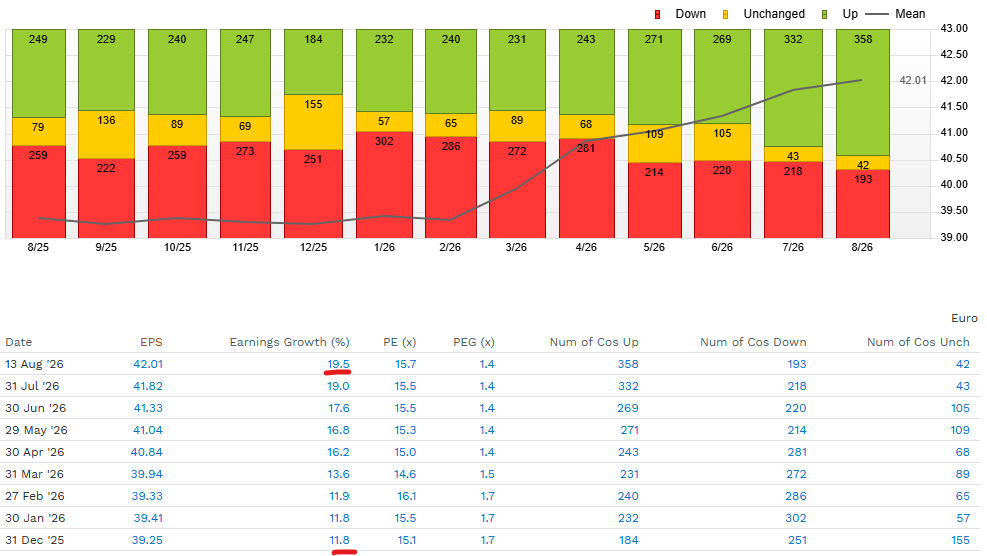
Chart of the week: European earnings growth estimate is now almost 20%.
Source: FactSet
In the above complex chart, we can see the following: The black line is how the earnings estimate has been evolving for the Stoxx Europe 600 index since last year. At the beginning of the year the earnings growth was about 12% , as highlighted in the table. This proved to be very low as the first quarter results started coming in, around April. Analysts started upgrading their estimates aggressively, partly because of the jump in Energy profits but also due to much better results from the AI-beneficiaries as well as Banks and other sectors. The current earnings growth stands at almost 20%, also highlighted in the above table. Hence there is no surprise that the index has moved almost 15% higher this year, following closely the earnings upgrades and we could argue that there is more room for stocks to move higher as valuations at the index level is still attractive (P/E 16).
The content of this document has been produced from publicly available information as well as from internal research and rigorous efforts have been made to verify the accuracy and reasonableness of the hypotheses used. Although unlikely, omissions or errors might however happen.
The data included in this document are based on past performances and do not constitute an indicator or a guarantee of future performances. Performances are not constant over time and can be positive or negative.
This document is intended for informational purposes only and should not be construed as an offer or solicitation for the purchase or sale of any financial instrument and it should not be considered as investment advice. The market valuations, views, and calculations contained herein are estimates only and are subject to change without notice. Any investment decision needs to be discussed with your advisor and cannot be based only on this document.
This document is strictly confidential and should not be distributed further without the explicit consent of Kendra Securities House SA.