Thoughts of the week.
Back in 1996, Toni Braxton’s hit “Let it flow” debuted at number seven on the Hot-100 and number two on the Hot R&B Singles chart, becoming her highest-debuting single. It eventually topped the Hot 100 chart for a week, and the Hot R&B Singles chart for two weeks, which was her first number one single on both charts. Not sure if President Trump has heard the song , but he probably whispered these words to President Putin, last week.
The US president surprised the world on Friday. He announced that Moscow had agreed to immediately release 300,000 tons of diesel “to the American and Global Marketplace, followed by another 500,000 tons in November and a further 1mn tons immediately thereafter”. An additional 3mn tons would be delivered based on the condition of Russia’s refineries, Trump said. Alexander Novak, Russia’s deputy prime minister in charge of the energy sector, told Russian news agencies on Friday that Russia would start to immediately lift all restrictions. The price of wholesale diesel for delivery in New York fell about 4.5 per cent, following the announcement.
Before opening the champagnes, let’s check whether these numbers can really be achieved. In the years leading up to 2025, Russia was the largest diesel exporter, with an average of 2.6mn tons of diesel a month transferred by sea. This means that they indeed do have the capacity and Russia can still pump crude, but with refineries running at around 60% because of severe drone damage, it can’t turn enough of that crude into diesel even for itself. In fact, Russia has banned diesel exports by producers until 31 October 2026 to protect its own market, and at one point it was even importing diesel and jet fuel from South Korea.
The announced deal has also political implications. Ukraine is already furious. Its military has spent months striking Russian refineries, which is the most effective way of squeezing further Moscow’s finances, while Washington has blamed those strikes for the record fuel prices. President Zelensky called the announced deal a sign of weakness that would help finance Russia’s war, but he offered instead a mutual moratorium on energy-infrastructure attacks over the winter. We have to note that Trump’s diesel waiver is relevant only to US sanctions, which run until April 2027; European restrictions on Russian fuel remain in force, as of the time of writing.
Whether this questionable deal is enough to sustainably move oil and diesel prices lower, is anybody’s guess. But quite often in markets, words are stronger than actions and Trump’s willingness to bring down energy prices almost at any cost is the key message, especially as the midterm elections are fast approaching.
Falling oil prices is a short-term positive catalyst for markets, as bond yields should probably move lower too. As we had mentioned several times, we had perhaps reached a breaking point as the bond market was flashing red, equity sector bifurcation became extreme and geopolitical tensions kept rising, all at the same time. A sharp drop in oil prices could be the valve that releases some of this rising pressure from markets. But if this happens, then wild rotations might emerge, as many investors and traders are not be prepared for a reversal of the latest trends which had been: sell Europe, sell consumer, buy only AI-related stocks.
If last week’s action is any guide, the markets could be ready to rotate. The Q3 earnings season which starts this week in the US might be the catalyst for this too. With Tech earnings expectations and hype continuously being raised, the market could be very easily disappointed, as it happened last week with OpenAI’s revised lower revenue growth. And last but not least, hedge funds and other momentum investors are short the above mentioned laggards and very long the crowded trades. To avoid any misinterpretations, in our portfolios we still have sizable exposure to AI-related names and Tech. But we have been building positions in laggards too, (perhaps too early) as great companies with solid fundamentals have been trading on sale. Diversification reduces volatility ahead of an exciting final quarter, with an Anthropic IPO, Q3 Tech results, US midterm elections and central banks raising further interest rates.
The week’s highlights.
The minutes of the last Fed meeting leaned on the dovish side. As a reminder, the decision to hike rates by 25bp was unanimous. The minutes of that meeting revealed the shared sentiment that there is no urgency to proceed immediately with another hike, although most board members seemed to agree that one more hike is probably needed by year end: “Most participants assessed that another increase in the target range for the federal-funds rate would likely be appropriate by year end”. “Participants emphasized, however, that they approached each meeting with an open mind and decisions at future meetings would depend on incoming information.”
President Trump said that the US will not attack Iran before the mid-term elections. As a reference, these are expected to take place in about three weeks (November 3rd). Such an announcement can have a short-term positive effect on oil prices and consequently on bonds yields, in combination with the Russian deal. Speaking of elections, according to the prediction platform Polymarket the possibility of Democrats winning the House is now estimated at 95% and winning the Senate at more than 65%. This means that there is a decent probability for the Democrats to sweep Congress.
According to an FT article, OpenAI’s annualized revenue is about $20bn less than the company had signaled. The company has recently told investors that its revenues were approaching $50bn on an annualized basis at the end of September, far short of the $70bn reported by the FT and other media outlets late last month based on information that was provided to investors during a funding round. The company responded that the $70bn target will be reached by year-end, still short of the initial end-2026 target of 100bn$ that was circulating recently among investors.
Markets’ reaction.
Global equities had a mixed weekly performance. The S&P500 registered a new record high during the week, finishing 1.2% higher, despite Technology ending with small losses (-0.5%). The rotation to laggard sectors was the main characteristic, with Energy (+3.6%), Staples (+3.6%), Healthcare (+2.6%), Financials (+2.3%) posting solid gains. Europe was also mixed, with Eurozone stocks down 1.5% but the Swiss SMI (+0.9%) and FTSE100 (+0.9%) helped the broad European indices remain flat for the week. The rotation into laggard sectors was also evident in Europe, with Staples (+3.1%) and Discretionary (+1.1%) posting positive returns. France was down 1.2%, bringing the YTD loss to 4.2%. In Asia, the tech-heavy Kospi has been treading water and is down almost 10% from its early October high.
Bonds were once again volatile, but finished the week on a positive note. The US 10yr yield rose to 5.33% before falling to 5.24%, something that helped equities recover. The 10yr Bund finished the week just below 3.50%, about 10bp below its recent peak. If oil prices begin a sustainable fall, yields are expected to move lower.
The dollar strengthened vs most major currencies. The EURUSD touched a low of 1.1150 as the Eurozone was “under attack” for most of the week, but finally climbed above 1.1200.
Gold paid a brief visit to the 4’100$ handle, but managed to rebound closer to 4’200$ , as the dollar weakened and yields fell on Friday.
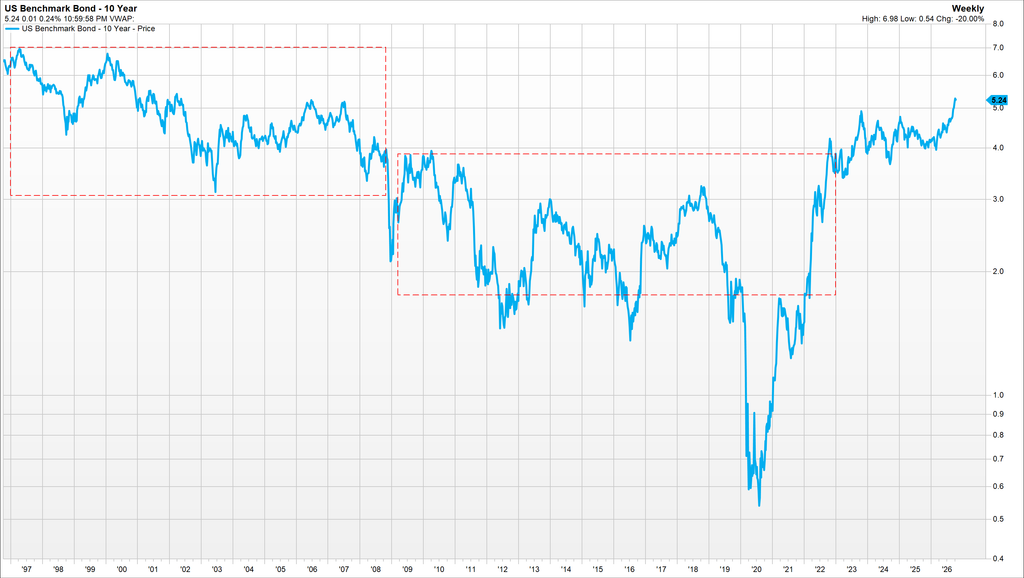
Chart of the week: Back to a more normal environment.
Source: KSH / FactSet
The above chart shows the 30-year history of the 10yr US Treasury bond. Many believe that the current levels are too high and “unheard of ” , but if you look in history we are simply back to a more normal interest rate environment, last seen in the early part of this century when there was no central bank intervention through quantitative easing (i.e. central banks buying massively bonds). The average yield of the 10yr bond in late 90s and early 00s was between 5% and 6%, until the 2008 global financial crisis. At that point the Fed took over and the rest of the central banks had also to intervene, especially as this crisis was followed by the Eurozone crisis just 2-3 years later. For more than a decade the 10yr yield found itself in abnormally low levels of 2-3%, while the pandemic pushed the yield to almost zero. The inflationary pressures that followed the pandemic and the geopolitical chaos of the last four years have created the necessary conditions for the 10yr to return to its normal range around 5%. The generation that grew up enjoying zero interest rates by major central banks and the US 10yr hovering around 2-3% might be shocked with the news. But it seems very likely that we have returned to a higher interest rate environment for a long period of time which means that expectations for equity valuations must adjust accordingly. On the positive side, the Fixed Income asset class can again produce solid returns on a medium term horizon , as yields will eventually stabilize in their new, much higher, trading range than the previous decade. The solid positive carry can guarantee very decent positive returns on a 3-5 year horizon, despite the week-to-week volatility. Having been negative on the asset class almost all year long, perhaps it is time to change our view.
The content of this document has been produced from publicly available information as well as from internal research and rigorous efforts have been made to verify the accuracy and reasonableness of the hypotheses used. Although unlikely, omissions or errors might however happen.
The data included in this document are based on past performances and do not constitute an indicator or a guarantee of future performances. Performances are not constant over time and can be positive or negative.
This document is intended for informational purposes only and should not be construed as an offer or solicitation for the purchase or sale of any financial instrument and it should not be considered as investment advice. The market valuations, views, and calculations contained herein are estimates only and are subject to change without notice. Any investment decision needs to be discussed with your advisor and cannot be based only on this document.
This document is strictly confidential and should not be distributed further without the explicit consent of Kendra Securities House SA.