Thoughts of the week.
It is not hard to imagine Tuesday night at the White House. Laying in a comfortable armchair with his favorite Diet Coke in his hand, President Trump was probably humming that famous Pet Shop Boys song, watching the “blue wave” flooding the US. His closer associates probably did not want to answer this question. But his Democrat enemies as well as voices within the Republican party, including that of Vice President JD Vance, were quick to blame the Iranian war and the spike in oil prices as the main reason for the onslaught. Truth to be told, it was not just Trump’s treatment of the Iran situation which made even MAGA voters angry. His unwillingness to put some form of control to the AI-trillionaires’ El Dorado backfired spectacularly, as he failed to see or underestimated the ever-growing citizen dissatisfaction with regard to the relentless buildout of data centers.
Lets us take a look at the seismic changes which took place in some states closely linked to the AI buildout. In Ohio, the democrat Senate candidate ran millions of dollars of ads calling his opponent “the face of data centers in Ohio” and won by five percentage points ! Ohio elected a new Governor too, the Democrat Mrs. Acton who is in support of placing stricter rules and oblige new data centers to cover all of their utility costs, use union labor and build on old industrial sites rather than farmland. In Texas, voters elected a Democrat, Latino, female Governor for the first time ever, Mrs. Hinojosa, who campaigned on a moratorium on new data center construction, stricter rules on water and power use, and an end to tax breaks for the industry. Texas Republicans also lost their Senate seat. An estimated 27% of all planned U.S. data center capacity is in that state. The new Georgia Governor, Mrs. Bottoms has also campaigned in favor of a statewide pause on new data center construction to study the effect on power bills, water supplies and communities.
As a recipient of this newsletter, you probably have read several times in the last few months about our anti-consensus skepticism on AI beneficiaries after their two-year rally, despite the fact that we still hold some of them (but much less than we used to). Our skepticism was not based on the view that AI is useless or a bubble; on the contrary we love and use the Technology and we believe it is the future. Our doubts about whether the shares of these companies will continue to be unstoppable in the medium-term were based on the extreme positioning of the market and the fact that we saw an inevitable slowdown in AI development in 2027, either due to supply constraints, or high financing costs, or regulatory issues or pushback by inhabitants, or any combination of these factors.
The most crowded part of the market, memory chips and semiconductors collapsed by more than 10% on Thursday, adding to their correction of the previous weeks. In fact and in case someone forgets, the AI beneficiaries weakness is not something new, as their shares have already peaked in mid-June, with periods of short-term rallies in between, which they never brought prices past those previous peaks. Other AI beneficiaries such as electrification and power generation companies also fell to new multi month lows. Our skepticism and caution have now been confirmed in full.
But we are not here to get good marks on a test or a “pat on the back”. We are here to manage portfolios and hence we have to be extra careful of what the next moves will be. On one hand, we are far more comfortable with the current market positioning, as leveraged traders and hedge funds have been wiped out. We are also more comfortable with valuations that have finally started discounting a slower AI development in 2027. But, on the other hand, we must also keep in mind that we are entering a new era in US politics until the next presidential elections in 2028. Republicans will probably join their Democrat peers to show a willingness to control and regulate the AI buildout, in order to win back votes from the “angry” part of the population. Leaving politics aside, we are also seriously concerned that financing of AI related companies could dry up and interest rates of related credit instruments could move further higher.
We are already in a healthier market environment, with less speculative positioning, lower concentration in a handful of stocks and with valuations that are now fair to attractive. A few months ago we had highlighted in a “Chart of the Week” the extreme concentration of semiconductor stocks in the S&P500 which at the time had reached a whopping 20% of the index. This has now dropped to 14% due to their large correction, which is still significant compared to previous years but more reasonable. We can also safely assume that previous stock price highs of most AI beneficiaries will be difficult to be regained in the next few months, but given oversold conditions and the huge community of traders and investors with Pavlovian behavior to buy-the-dip, the AI theme will most probably recover and could even stage a rally. This could offer an opportunity to perhaps further decrease or alter our current exposure to the theme. There is already talk that the current correction is more like 1998 before the 1999 huge rally and not like 2000 when Tech/Nasdaq fell into a three year bear market. Nobody really knows. We remain vigilant, diversified and active.
The week’s highlights.
Eurozone October CPI rose to 4%, as expected, while core inflation remained at 2.5%, also as expected. The rate hike by the ECB in December has now been largely cemented, although the significant changes in US politics and the recent drop in oil prices could provide ground for a debate when the governing council meets next.
The US labor market data were stronger than expected. The monthly non-farm payrolls jumped to 165k against expectations for just 60k, while the unemployment rate fell to 4.1%. The weekly jobless claims fell to a new multi-month low and JOLTS jobs openings also jumped, painting a rosy picture for the labor market. The Fed has no other choice but to raise interest rates in their last meeting for the year, in December.
Markets’ reaction.
Global equities continued to trade in a volatile manner, with Europe outperforming the US again. The Technology mini crash (-8% for the week) dragged down the S&P500 by almost 3%, while Europe was broadly higher, boosted by rallies in Staples, Financials, Discretionary, Healthcare. Semiconductor stocks fell to the lowest level since April, down more than 20% since early October. Interestingly, on a year-to-date basis, Staples and Healthcare in the US are now outperforming Technology !
Bonds continued to move higher and yields lower. The 10yr US Treasury has dropped to 4.85% while the 10yr Bund fell below 3.30%, helping balanced portfolios weather the recent equity turmoil. The move had been initially driven by short covering, but now investors are betting on a slowdown in the US economy, if the AI buildout stalls.
The EURUSD traded in a tight range around 1.1200, after reaching a low of 1.1100 before the elections. The CHF attracted bids, a typical behavior when there is stress in markets.
Gold rose back above 4’000$, but the move higher is primarily due to short covering and speculative positioning. According to available data there is no evidence of strong physical buying yet.
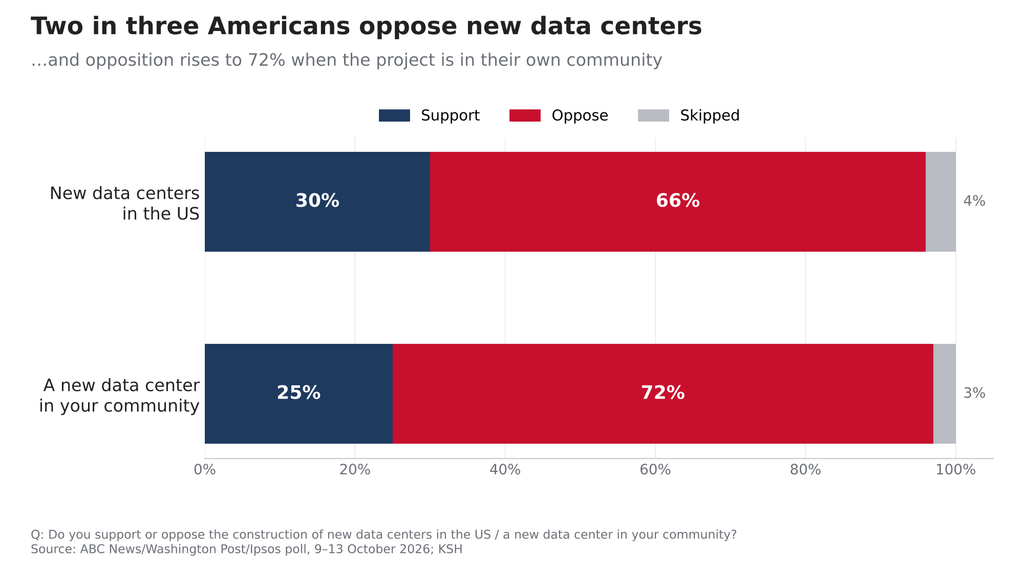
Chart of the week: Data centers are popular with investors, not with voters .
Sources : UBS Research
As the elections clearly demonstrated, the AI build-out has a public-opinion problem. A recent ABC News/Washington Post/Ipsos poll showed a staggering result, where two in three Americans said they oppose building new data centers in the US. When asked if the project would be in their own community, then opposition rose to 72%. As we have mentioned above, the real control over these projects is at the state and not the federal level, as local authorities are the ones providing the permits, the siting rules, they control the grid-connection queues and power pricing as well as the tax incentives.
The content of this document has been produced from publicly available information as well as from internal research and rigorous efforts have been made to verify the accuracy and reasonableness of the hypotheses used. Although unlikely, omissions or errors might however happen.
The data included in this document are based on past performances and do not constitute an indicator or a guarantee of future performances. Performances are not constant over time and can be positive or negative.
This document is intended for informational purposes only and should not be construed as an offer or solicitation for the purchase or sale of any financial instrument and it should not be considered as investment advice. The market valuations, views, and calculations contained herein are estimates only and are subject to change without notice. Any investment decision needs to be discussed with your advisor and cannot be based only on this document.
This document is strictly confidential and should not be distributed further without the explicit consent of Kendra Securities House SA.