Thoughts of the week.
Not a week passes without concern on the AI theme. It is already two months since the Tech correction started, with the sector down 15% since then. Initially based on worries about the negative cash flows and the ever-increasing debt level of the hyperscalers which could lead to a potential slowdown in data center development, then the Democrat sweep of US Congress sparked absolute panic, with Nasdaq cratering 5.5% in a single day. Last week, the theme was dealt one more blow, when we received the breaking news that one of the world’s biggest supporters and promoters for the AI buildout , Mr. Jensen Huang, is in trouble. He was final ousted from the company he co-founded. Having Microsoft Outlook down globally for several hours on Friday did not offer any help to the sentiment. The upcoming changes in the world’s largest semiconductor company do not only concern its shareholders but have the potential to inflict profound consequences on the whole industry.
Nvidia has become the DJ who controls the music. Under Mr. Huang’s aggressive approach, the company has become the “Central Bank of AI“, a key source of funds for a host of AI industry participants including the neo-clouds, LLM developers, ecosystem partners and suppliers. Nvidia has been taking equity stakes in AI labs or neoclouds (companies that rents out GPU computing power, such as CoreWeave, Nebius or IREN) and it has been guaranteeing debt and leases of such companies. These companies usually have highly leveraged balance sheets and are running operating losses, as they are in their explosive growth phase, where spending significantly outpaces revenues . With Nvidia’s backing, they can now borrow even more from banks, from the bond markets and/or from private credit funds and in return they are obliged to spend on Nvidia chips. Furthermore, Mr. Huang had recently promoted a framework of up to $500bn with major Wall Street firms, to package AI chips as collateral for loans and bonds sold to investors, a move that raised eyebrows and brought memories of 2008 financial engineering.
The interim CEO is the company’s CFO, Mrs Kress, who is known for being far more conservative about financing agreements of the AI sector. As an example, just three months ago she managed to cut the guarantees that the company will offer to OpenAI for its mega project in Ohio, to 105bn$ down from the original 250bn$ that Mr. Huang had pushed for. For this, we now know that she was ridiculed by Mr. Huang, during a team meeting. Her being at the helm of the company for now, could actually be good news for Nvidia, but bad news for the largest beneficiaries of the company’s financial support: OpenAI, Anthropic, SB Energy (Softbank subsidiary), Coreweave, Intel. The group also owns participations in other neoclouds (Nebius, IREN, Nscale), chipmakers (Mediatek, Marvell, Coherent, Lumentum), and other AI beneficiary companies including Nokia, Synopsys and Corning, investments which could be scaled back and/or fall under more scrutiny.
It is really unknown what Nvidia’s board will decide on the future CEO , whether a “Jensen” type of personality will be in charge or a more conservative executive will have to drive the company through a series of federal and congressional investigations, which have already begun. Given the accusations of not reporting accurately its Asian sales and the leakage of high-end chips to China despite the ban, we must assume that the company will be in much greater scrutiny than before. The US government and the Congress are already circling Nvidia and new limitations on exports could be passed within weeks, as this is one of the few subjects that both Republicans and Democrats are in agreement. The US Treasury Secretary Scott Bessent said over the weekend, that Nvidia has to find its new chief executive outside the company, saying the company needs a “dramatic shake-up“.
Markets have been sending their own warnings for months. Share prices of the neoclouds we mentioned above have collapsed more than 50% in the last few months, as investors have grown skeptical on their survival, while other beneficiares (Caterpillar, European & US Industrial etc.) have also corrected 30-40% since their peak in early summer. Credit markets have also responded to investor skepticism. The spreads of mega cap Tech companies have exploded higher, with borrowers demanding higher interest rates for them. This increases further their already high financing costs. Again in terms of credit, the neoclouds are the weakest link : CoreWeave’s credit spread nearly doubled in the last six weeks, and this is the largest one with the backing of Microsoft. The company’s bonds are now yielding 15% in USD. According to reports, banks are also stepping back, hesitating to fund new AI deals even with guarantees from leading tech companies and GPU-backed loans are being marketed at steep discounts.
The music will stop if and when financing dries up. For now, we have experienced only small scale earthquakes that have produced minor cracks in the system. Having said that, the latest quarterly report by Softbank (a leveraged, Tokyo-based multi-billion dollar investment holding company focused on artificial intelligence, semiconductors, and global technology) was probably a larger one. The company announced a steep loss driven by write-downs in the value of investments related to data centers (its major one being the Ohio project mentioned above, guaranteed by Nvidia) as well as losses in its AI-related holdings. Its credit spread rose to 500bp, the highest since 2022, with the yield of its bonds spiking higher than 10%. For those who probably do not know, Softbank was one of the early victims of the 2000 Tech crash, with its shares losing 75% in a matter of two months, eventually losing 90% of their value by the end of that year and almost went bankrupt.
All in all, we can still hear the music and we are dancing around the chairs, still being exposed to the theme which has occupied the global investment world for two years now. European companies who have benefitted from the AI deployment have returned to valuations that have already discounted a slowdown, and we should not forget that the same companies are also exposed to other secular themes such as electrification. Hence we feel more comfortable with their valuations than a few months ago and our cautiousness on the theme during summer has been rewarded. At the same time, the non-AI sectors and stocks have managed to post a significant recovery from the year’s lows, helping indices and diversified portfolios weather the Tech/AI correction very well.
Anthropic’s IPO as well as Nvidia’s quarterly results in the next few days will be key events to watch. Is the DJ going to keep the music loud and clear ? Nobody knows. But we do hope so and we should also note that we are entering a traditionally good period for equity markets until year end, with the holidays just around the corner.
The week’s highlights.
US inflation rose more than expected in October. The headline CPI rose 0.35% vs expectations for 0.2%, but a smaller monthly increase than in the past two months (0.40% in August and 0.65% in September). Core CPI prices rose 0.30%, also above expectations. The 12-month changes of inflation were not published this month as a result of the last year’s government shutdown, when no inflation numbers were published. That said, analysts estimated that October’s annual inflation is close to 4%.
Several Fed officials went public with a hawkish message. Governor Waller suggested that a 50bp hike could be on the table next month, Dallas Fed President Lorie Logan called for at least two more 25bp increases to move policy into modestly restrictive territory, followed by a potential pause. Chicago Fed President Austan Goolsbee described October inflation as “borderline disturbing,” citing stubborn services inflation and risks of broader overheating. Governor Michelle Bowman signaled she could support a hike next month amid persistently elevated inflation. New York Fed president John Williams warned that US inflation was too high and that the Fed needed to take action over time to ensure inflation shifted back to 2%. Only a few weeks ago he said one more hike was appropriate this year, but there was no need for rates to rise further in 2027. Now his remarks have shifted towards a gradual but continued shift up in rates. In his words “the data is speaking very clearly to us — the economy is strong, labor market continues to strengthen and inflation is persistent”.
Trump, Jinping and Putin are scheduled to meet this week in China. Some are calling the meeting “Yalta 2.0” after the 1945 conference in Crimea, where US President Franklin D Roosevelt, British Prime Minister Winston Churchill and Soviet Premier Joseph Stalin decided the post-second world war international order. But expectations for most political analysts are low for a breakthrough outcome. On Ukraine’s issue, there seems to be a US offer for them to surrender the Donbas region in return of a NATO membership, in order to end the multi-year conflict. This is, of course, a matter that eventually the Ukrainian people will decide, through a referendum, as Zelenskyy cannot decide unilaterally on this.
Markets’ reaction.
Global equities rebounded last week, but Europe still slightly outperformed the US. The S&P500 rose by 2.5%, as Technology rebounded despite the troubles of Nvidia. All sectors posted solid gains for the week, with Energy, Industrials and Tech at the top of the list. The EuroStoxx 50 index jumped 3.5% but remains about 4% off its summer peak , while the broad Stoxx 600 index rose 2.5% at a new record high. On the contrary, Asian markets were under profit taking with the memory-chip-heavy Kospi index down 2% and Hang Seng losing more than 3%. Local Chinese equities were also lower by 1% for the week.
Bonds sold off after the US inflation data, and the above mentioned “avalanche” of Fed speakers pointing to more hikes in 2027. The US 10yr yield rose to a high of 5.15%, up from 4.85% just two days ago, while the 2yr yield had its largest daily change in decades, approaching again 4.90%. The EUR curve also moved higher, but in a more muted way. The 10yr German Bund approached 3.40% again.
The dollar rallied as market expectations for hikes increased again. The EURUSD traded below 1.1100 for the first time this year, falling to a low of 1.1050.
Gold sold off, as a strong dollar and higher USD yields played their role. The metal fell below 3’900$ , down more than 7% in a matter of days, confirming our view that the move higher was rather a speculative/fast money trade than a true pick-up in physical or investor demand.
Chart of the week: Will 2026 be like 2018?
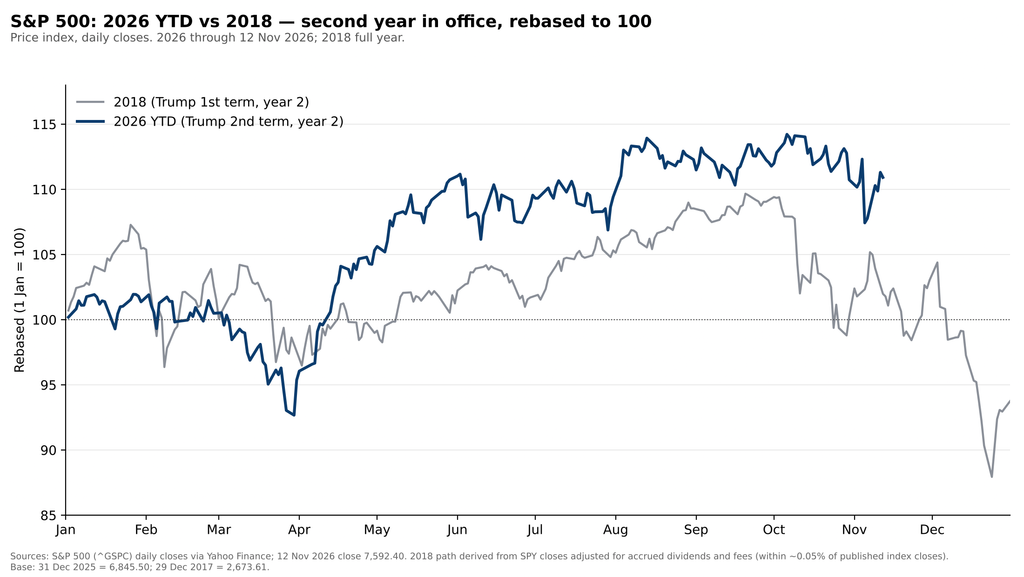
The above chart is primarily for illustration purposes and not meant to lead to investment decisions. The grey line is the S&P500 index in 2018, which is Trump’s second year in office during his first term (2018) and the blue line is his second year during the current term. The lines look strikingly similar. As in 2018, the first quarter was negative, followed by a sharp rebound which stalled in late September, early October. If we look what happened in 2018 until year end, despite some violent short-term rallies the market sold off into late December. The main reason was the Fed, which kept raising interest rates. A late after-Christmas party saved the year from steep losses. Interestingly, the EURUSD has also been trending with the same pattern in Trump’s first year in office when we compare 2017 and 2025, a fact that we highlighted back in December 2024. And if one looks to 2026, the EURUSD has been trending in a very similar pattern. Lets just hope that 2018 is not repeated in the stock market.
Source: FactSet, KSH.
The content of this document has been produced from publicly available information as well as from internal research and rigorous efforts have been made to verify the accuracy and reasonableness of the hypotheses used. Although unlikely, omissions or errors might however happen.
The data included in this document are based on past performances and do not constitute an indicator or a guarantee of future performances. Performances are not constant over time and can be positive or negative.
This document is intended for informational purposes only and should not be construed as an offer or solicitation for the purchase or sale of any financial instrument and it should not be considered as investment advice. The market valuations, views, and calculations contained herein are estimates only and are subject to change without notice. Any investment decision needs to be discussed with your advisor and cannot be based only on this document.
This document is strictly confidential and should